Tuesday, October 23, 2007

This blog is moving

As of 17:00 London, UK time, 23 October 2007, my blog will, DV, be moving to the Financial Times website. The new URL will be http://blogs.ft.com/maverecon/

For RSS readers, the new address will be http://blogs.ft.com/maverecon/rss.xml

Posting comments should be possible as before.

The Single Mother of All Liquidity Enhancement Conduits

What’s behind the Single Master Liquidity Enhancement Conduit (M-LEC) aka 'Superfund' proposed by Citigroup, JPMorgan Chase and Bank of America, with the active verbal encouragement of the US Treasury?
Exploding amounts of opaque financial instruments held by growing numbers of opaque financial institutions made a significant contribution to the perfect storm that resulted in widespread disruption of wholesale financial markets throughout the OECD (with the exception of Japan). Interbank lending dried up, and interbank spreads over official policy rates rose sharply; many collateralised debt obligations (CDO) markets, collateralised loan obligations (CLO) markets and asset-backed commercial paper (ABCP) markets closed down completely.

Prominent among the opaque financial instruments are a wide range of complex structured finance products based on the securitisation, bundling, tranching, enhancement and recombination of securitised illiquid assets and cash flows like mortgages, car loans and credit card receivables. Leading examples of opaque financial institutions are the Structured Investment Vehicles (SIVs) and Conduits (SIVs closely associated with a particular bank) whose assets M-LEC is supposed to purchase. All these SIVs, Conduits and similar constructions are off-balance-sheet vehicles created mainly by commercial banks (some by investment banks), mainly to avoid regulatory burdens, including capital adequacy requirements, reporting requirements, governance requirements and other restrictions on the asset and liability sides of banks' balance sheets.

This raises the obvious question as to whether the proposed sale by a number of opaque off-balance sheet vehicles of between $75 bn and $200 bn of illiquid opaque asset-backed securities (ABS) to a single huge opaque off-balance sheet vehicle, M-LEC, funded by the three above-mentioned American banks (and any other institution willing to join) represents a move towards better functioning ABS and ABCP markets and towards fair-value or fundamental-value pricing of these securities? It is possible, but not likely.

Clearly, if SIVs and Conduits have to unload large quantities of illiquid opaque financial instruments on an unwilling market because these SIVs and Conduits can no longer refinance their short-maturity liabilities in the defunct ABCP markets, the ‘fire sale’ prices realised by such distress sales would indeed be distressing to the sellers. These same prices would, however, be exhilarating to the buyers - the vulture funds and other deep pockets/smart money investors that are always on the look-out for just such opportunities. Since these SIVs and Conduits have no significance for systemic stability, their losses (which are mirrored by profits earned by their counterparties) are of no policy relevance, and even their bankruptcy (which would inevitably involve some net real resource cost) would be a second-order issue.

The ‘fire-sale’ prices that might be realised if these SIVs and Conduits had to dump their illiquid assets on a reluctant market would also impact adversely on holders of similar illiquid assets, even if these assets were not offered for sale at the same time. ‘Fair value’ accounting may require marking to market of these assets using the distressed valuations achieved in the sales by SIVs and Conduits. Any institution holding such assets, including banks, could take a serious hit on their balance sheets as a result.

An obvious alternative to a fire-sale of illiquid structured finance instruments by the SIVs and Conduits to the market would be for commercial banks either to purchase the instruments directly from these off-balance-sheet vehicles, that is to take the securities ‘on balance sheet’, or to purchase the SIVs and Conduits themselves, that is, to take the off-balance-sheet vehicles ‘on balance sheet’. The argument against that, from the perspective of the banks, is the same as the argument for creating the off-balance-sheet vehicles in the first place: it would use up capital and impose commercial banking standards of reporting, transparency and governance on the securities/former off-balance-sheet vehicles.

If Citigroup, JPMorgan Chase and Bank of America are exposed to such vulnerable SIVs and Conduits, whether as shareholders, as creditors or providers of (as yet) undrawn lines of credit, for reputational reasons or simply because they would not like to have to value their own holdings of opaque structured finance vehicles at bargain-basement prices, it is their right to try and limit the damage to their bottom line through any set of actions that does not violate laws or regulations. It is possible that by trying to make a market in illiquid securities (especially if a wide cross-section of US and international banks were to participate in the venture) they would restore liquidity to a currently illiquid set of markets and do some social good as well.

Even if we grant this argument, is this the best that could be achieved from the perspective of the efficient functioning of the financial system? Hardly. If, as I believe to be the case, the proliferation of regulation-avoiding off-balance-sheet vehicles is a major contributor to our current problems, scant progress is made by the creation of M-LEC - yet another gigantic off-balance-sheet vehicle. If banks are going to bid for the complex and poorly understood securities held by non-transparent SIVs and Conduits, they should do so directly, taking the illiquid securities or the off-balance-sheet vehicles themselves onto their own balance sheets, rather than through this off-balance-sheet vehicle to end all off-balance-sheet vehicles. With a bit of luck, the sponsoring banks will in any case have to consolidate their shares in M-LEC with their own accounts, but this issue is still unresolved.

In view of the widespread lack of enthusiasm among the rest of the US and international banking community for signing up for M-LEC, however, it seems more likely that the institutions that proposed this Mother of All Liquidity Enhancement Conduits are the institutions most exposed, directly or indirectly, to the opaque SIVs and Conduits holding large portfolios of the most opaque and illiquid structured financial instruments targeted by M-LEC, and to the likely fallout from any forced, rushed liquidation of these portfolios. The deafening silence of the Fed about the merits of M-LEC reinforces this impression.

Monday, October 22, 2007

Legalise it ! (yet one more argument)

From the Washington Times, October 19, 2007, p. 15: "KABUL The top U.S. general in Afghanistan said yesterday he estimated that Afghanistan’s rampant opium poppy cultivation was funding up to 40 percent of the Taliban-led insurgency. Gen. Dan McNeill, head of the NATO-led International Security Assistance Force, added he had been told by an international specialist that his figure was likely low and could reach up to 60 percent..." Nuff said.

Thursday, October 18, 2007

"These Meetings are Carbon Neutral" (Not!!)

This blog comes from Washington DC where the great and the good of the world of international finance –ministers of finance, central bankers, national and international financial bureaucrats, private financiers - and thousands of hangers-on have gathered for the 2007 Annual Meetings of the World Bank Group/IMF. When you enter the main World Bank building, its Atrium is dominated by a huger banner proclaiming “These Meetings are Carbon Neutral”. Even a moment’s reflection makes it obvious that this statement cannot be true. Let’s take the counterfactual (the benchmark against which carbon-neutrality will be judged), to be an otherwise identical world in which the 2007 Annual Meetings are cancelled (well ahead of time) and not replaced with any other similar event or set of smaller-scale regional events. For those attending the Annual Meetings who are normally based in Washington DC anyway, I will assume that the carbon footprint is unchanged. Actually, with the meetings cancelled there will be fewer meetings, less jumping in and out of taxis and less dining out on expense accounts, so even for the Washington DC crowd, cancelling the Meetings would, in all likelihood reduce CO2eq (Carbon dioxide- equivalent) emissions, but I am keen not to overegg my case. For those coming to Washington DC for the Annual Meetings from elsewhere, the cancellation of the Meetings is likely to result in a reduction in CO2eq emissions when we compare their activities in Washington DC to their activities had they remained at home (playing with the children/grandchildren etc.). This is because expense-account living in DC (fine food and drink, air conditioned hotels and meeting venues, other official and unofficial activities) is likely to be more CO2eq-intensive than the activities likely to be pursued under the alternative scenario at home. Finally, there is the carbon footprint associated with transporting many thousands of meeting participants to Washington DC. They come, literally, from all over the world. The vast majority travels by air. It is highly unlikely that the total number of flights is not higher under the Annual Meeting takes place scenario than under the Annual Meeting does not take place scenario. Likewise, the average load of passengers and luggage carried by a typical flight is likely to increase as a result of the Annual Meetings. CO2eq emissions are increasing in both the number of flights and in the load carried per flight. So the statement “These Meetings are Carbon Neutral” is obviously untrue. That raises the question: are those who dreamt up this slogan lying, stupid or both? The use “These Meetings are Carbon Neutral”, could be an application of the principle of lying attributed to Joseph Goebbels: “If you lie, lie big”. [1] With the Nobel for peace going to Al Gore and the IPCC, being green (or at any rate appearing to be green) is a good thing. If you can talk the talk but cannot walk the talk, just fake the walk. Another possibility is that the World Bank’s definition of carbon-neutral is so ludicrously restrictive, that the statement is both correct and utterly misleading. It could mean no more than that the air conditioners have been turned down a few degrees, that the toilet paper is recycled and that so-called carbon offsets have been purchased by the organizers in an amount equal to the net CO2eq emissions created by the meetings. I have argued elsewhere that the carbon offset industry is a gigantic fraud and massive waste of resources. The World Bank should take that banner down.
--------------------------------------------------------
[1] Some of the best-known quotes are probably incorrectly attributed to Goebbels. They include "If you tell a lie big enough and keep repeating it, people will eventually come to believe it." and "The bigger the lie, the more it will be believed." Goebbels did assert that something close to the principle attributed to him was practiced by the English. In his paper "Churchill's Lie Factory" he said: "The English follow the principle that when one lies, one should lie big, and stick to it. They keep up their lies, even at the risk of looking ridiculous." - Joseph Goebbels, "Aus Churchills Lügenfabrik," 12. january 1941, Die Zeit ohne Beispiel.

Wednesday, October 17, 2007

Simplify tax regime with common rate on all (capital) income

An earlier version of this blog appeared as a Letter to the Editor in the Financial Times of 18 October 2007.

Of course the UK Chancellor of the Exchequer is being attacked for abolishing taper relief (a capital gains tax rate of 10 percent on an arbitrary selection of capital gains and on other capital income items masquerading as capital gains) and setting a uniform capital gains tax rate of 18 percent. Those who complain are those who stand to lose. Special pleading always masquerades as the defence of the common good: the losers want us to believe that their loss is not only painful to them, but also unfair and damaging to the UK economy. The Chancellor should not listen. Taper relief has no more justification on grounds of efficiency or fairness than would tape worm relief. Further reform of the CGT is required, integrating it fully with the taxation of other forms of capital income, and indeed with the taxation of labour income. The main reasons are tax administration and the preservation of the tax bases for capital income and labour income.

Through trivially simple financial engineering (varying dividend pay outs, borrowing and share repurchases) listed companies can seamlessly transform dividends into interest or capital gains. The same can be achieved by unlisted companies when their owners sell the business. This means that, for simple tax administration reasons and to preserve the capital income tax base, only a common tax rate for all capital income, dividends, capital gains and interest, makes sense. Sector, holding period, type of capital, nature of ownership, size of firm, corporate form are all irrelevant.

That only leaves the common tax rate on all forms of capital income to be decided. Efficiency dictates that you tax things at a higher rate the lower its elasticity of demand or supply. In the long run, capital is in infinitely elastic supply. This suggests a zero marginal tax rate on capital income is optimal. In the short run, capital is given – a zero supply elasticity. This suggests confiscatory taxation is optimal. Are we in the short run or in the long run? You take your pick.

Furthermore, most labour income in the UK is in fact capital income, the return on risky investment in human capital – education, training and other skills acquisition. Therefore, to avoid distortions, labour income and all capital income should be taxed in the same way. There also is a tax administration and income tax base preservation argument for taxing labour income and capital income the same way. In small enterprises, where the same persons are both shareholders and workers, income can be transformed seamlessly from wages into dividends and vice versa.

Both efficiency and fairness would be served by taxing all labour income and all capital income the same way. There is no case, of course, for a separate corporation tax. Only natural persons – the beneficial owners of capital should be taxed. There may be a tax administration case for collecting some of the personal capital income tax at the level of the company, as a withholding tax, but there should be full offset of such withholdings.

So, to preserve capital income and/or labour income as a tax base, it is necessary to add together each person’s wages, dividends, interest income and capital gains and to apply a single tax schedule to the total. The highest marginal tax rate on capital gains would therefore be 40 percent, the same as it is for wages and dividends.

A final benefit of my proposed simplification of the capital taxation regime is that it would lift the burden of guilt of engaging in privately profitable but socially unproductive labour from tens of thousands of tax lawyers, tax accountants and other tax efficiency experts and free them for socially productive labour.

Monday, October 15, 2007

Misplaced Trust: Inconvenient truths about the UN’s global warming panel

The following is the text of an op-ed article, written by David Henderson which appeared in the Wall Street Journal Europe on 11 October 2007. I think it is sufficiently interesting and worrying in its implications for it to be reproduced here.

Governments across the world are mishandling climate-change issues. Policies to curb ‘greenhouse-gas’ emissions too often take the form of costly specific regulations, rather than a general price-based incentive such as a carbon tax. More fundamentally, there is good reason to question the advice on which governments are basing their policies.

This advice is brought together through an elaborate process which governments have themselves created. The process is managed by the U.N. Intergovernmental Panel on Climate Change (IPCC), established in 1988. This panel is made up of government officials, not all of whom are scientists.

The IPCC process has since produced four massive Assessment Reports, designed to provide the basis for climate-change policy. These cover the whole range of issues, including economic, scientific and technical aspects. The latest in the series, AR4, will be completed next month. It will run to more than 3,000 pages, and its preparation has involved a network of some 2,500 experts.

Because of this extensive and structured expert participation, the IPCC process and its findings are widely taken to be professionally above reproach. Yet the expert network is only one of three main groups of participants in the process. The Panel itself, at the center of the process, is a separate body from the network. Third are the national-level agencies—the policy makers—that it reports to.

Governments have formally laid down, in the “principles governing IPCC work,” that Panel reports “should be neutral with respect to policy.” But this instruction can apply only to the expert reporting process. As officials, the Panel members and those who appoint them are of course identified with the policies of their governments. And virtually all governments are formally committed, within the 1992 UN Framework Convention on Climate Change, to the “stabilization of greenhouse gases in the atmosphere at a level that would prevent dangerous anthropogenic interference with the climate system.” Since 1992, the risks arising from human-induced global warming have been officially taken as proven. Policies have been framed accordingly.

These committed Panel members, and their equally committed parent departments, provide the lists of persons from which the expert network is largely chosen. They also review, amend and approve the draft Assessment Reports. Hence departments and agencies which are not—and cannot be—neutral in relation to climate-change issues are deeply involved, from start to finish, in the reporting process.

Policy commitment often shades into bias. From the outset, leading figures within the IPCC process have shared the conviction that anthropogenic global warming presents a threat which demands prompt and far-reaching action. Indeed, had they not held this belief, they would not have been appointed to their positions of influence. Both they and their ministers are apt to make confident, alarmist statements which go well beyond the more guarded language of the Assessment Reports. A notable instance was the October 2006 joint statement by two European prime ministers that “We have a window of only 10-15 years to take the steps we need to avoid a catastrophic tipping point.”

The expert reporting process itself is flawed, in ways that reflect this built-in high-level official bias. Despite the numbers of persons involved, and the lengthy formal review procedures, the preparation of the IPCC Assessment Reports is far from being a model of rigor, inclusiveness and impartiality.

A specific weakness in some IPCC documents is the treatment of economic issues, which is not professionally up to the mark. One aspect of this has been the use of invalid cross-country comparisons of real GDP, based on exchange rates rather than purchasing power parity estimates.

A basic general weakness is the uncritical reliance on peer review as a qualifying criterion for published work to be taken into account in the assessments. Peer review is no safeguard against dubious assumptions, arguments and conclusions if the peers are largely drawn from the same restricted professional milieu. What is more, the peer-review process as such is insufficiently rigorous, since it does not guarantee due disclosure of sources, methods and procedures.

Failures of disclosure, such as many journals would not tolerate, have characterized published work that the IPCC has drawn on. The Panel has failed to acknowledge this problem and take appropriate action to deal with it. The issue is simply evaded in the relevant sections of AR4.

So far, despite the prospective high costs of what could be mistaken policies, governments have paid little attention to telling outside criticisms of the IPCC process. As a former Treasury official, with later close dealings with economics and finance ministries in OECD member countries, I have been surprised by the way in which these ministries have accepted uncritically the results of a process of inquiry which is so obviously biased and flawed.

Even if the IPCC process were beyond challenge, it is imprudent for governments to place such heavy reliance, in matters of extraordinary complexity where huge uncertainties remain, on this particular source of information, analysis and advice. In fact, the process is flawed, and this puts in doubt the accepted basis of official climate policies.

In relation to climate change, there is a clear present need to build up a sounder basis for reviewing and assessing the issues. Governments should ensure that they and their citizens are more fully and more objectively informed and advised.

Two broad lines of action could be taken to this end. One is to improve the IPCC process, by making it more professionally representative and watertight. The other is to go beyond the process, by providing for alternative sources of information and advice. An independent expert review of AR4 would be a good place to start.

Mr. Henderson, a former chief economist of the OECD, is a visiting professor at the Westminster Business School in London.

Saturday, October 13, 2007

Long live debt!

I would like to make a deal with the Right Rev Peter Selby, Bishop of Worcester from 1997 to 2007. I promise not to make public statements about the merits of the Trinitarian doctrine (a form of higher theological mathematics asserting that 3 = 1). In return I would like the Bishop not to write any more nonsense about credit and debt.

In today’s Credo column on the Faith page of the Times of London (“It’s time to stop giving credit to our culture of debt”, The Times, Saturday October 13, 2007, p. 83) the Bishop produces a number of canards about debt. Unencumbered by logic or facts, the Bishop makes a slew of assertions that are, at best, unproven and at worst plain wrong.

Assertion 1: The Jubilee 2000 campaign, advocating debt relief for the poorest nations of the world, "was a remarkable achievement". Case unproven. The Bishop makes the common mistake of confusing poor countries and poor people. The debt relief in question is the forgiving of debt owed by the governments of the poorest nations. It is quite possible, and in a many cases indeed likely, that the vast majority of the citizens of these poorest nations may have been made worse off by the cancellation of part or all of the debt owed by their governments. Most of the poorest countries have appalling governments - repressive, corrupt, incompetent and inefficient. Unlike the vast majority of the population, the rulers of the poorest countries often are rich – their wealth stolen from the people. Debt forgiveness consolidates the hold of these disastrous governments on power and postpones the day that they can be held to account. When trying to help the poor ‘do no harm’ should be an overriding concern. Jubilee 2000 violated the ‘do no harm’ maxim.

Assertion 2: The need to get across “a systemic analysis of the nature of runaway debt, its roots in the creation of money by lending and borrowing, and the potential dangers for the world of both domestic and international debt.” Here the Bishop makes a factual statement about runaway debt. Where is (was) this runaway debt? The UK? The US? Everywhere in the world? Clearly, one can point to specific instances of excessive borrowing. Some households in the US and the UK have undoubtedly engaged in this. Elsewhere there is too little debt and borrowing. In the People’s Republic of China, for instance, it would probably be welfare-enhancing for the government to raise spending on education, health and environmental investment, and to finance at least part of this by borrowing, thus absorbing the excessive saving of Chinese households and public enterprises. Apart from his factual errors, the Bishop also confuses money creation with credit and borrowing. One can have lending and borrowing without money creation and money creation without lending or borrowing. The Bishop is confused about what money is, how it is created and what it does. He is in good company. Most people haven’t got a clue about the meaning and modalities of money. But fortunately, most monetary ignoramuses don’t display their ignorance by writing about it in the Times.

Assertion 3. “It is obvious that if you allow financial institutions to make huge profits by lending large multiples of the deposits they hold, you are allowing them to create money”. This is complete gobbledegook. For those who care, there are many operational definitions of money, ranging from narrow money (coin and currency plus commercial bank deposits with the central bank) to broader monetary aggregates, typically the sum of coin and currency in circulation, plus some subset of the deposits of certain deposit-taking institutions, plus some of the close substitutes for these deposits. ‘Creating money’ – an unfortunate and imprecise phrase that appears to attribute divine powers to the ‘money creating’ institutions – does not require financial institutions to make huge profits; neither do financial institutions that make huge profits necessarily create money. If financial institutions lend huge multiples of the deposits they hold, they must be financing that lending out of non-deposit resources (the wholesale markets, for instance, as Northern Rock did). This may have been reckless, but has nothing to do with money creation.

Assertion 4. “This failure of understanding has led to the use of debt as an instrument not just for uncontrolled personal consumption but also for building hospitals, schools and even prisons. The disciplines of living within your means, of allowing public functions to be provided by democratically accountable institutions, and of not using tomorrow’s resources today are forgotten as the young are trained in indebtedness as a condition of obtaining their tertiary education”. This is complete nonsense. The institutions and financial instruments that permit borrowing and debt (the cumulative total of all past net borrowing), represent a wonderful manifestation of human ingenuity – the Bishop might even call it a gift from God; I certainly would. Without borrowing and debt, each household, each firm and each government could only invest what it saves itself. That would lead to gross inefficiency and a colossal waste of resources. The financial means for financing investment are not necessarily distributed in the same way as the capacity to come up with productive and profitable investment projects. Without debt and borrowing, each family, enterprise and government would have to be financially self-sufficient. The creation of enterprises on a scale larger than cottage industries would have been extremely difficult. Material standards of living would be at the level of India and China before the 1980s.

Consider the state of UK infrastructure (social overhead capital). Transportation infrastructure is sub-standard and clapped-out. Many hospitals are a disgrace; many primary and secondary schools are in need of further capital investment; there is prison overcrowding. Clearly, there is a strong case for large-scale catch-up investment in infrastructure. To finance all of this temporary investment boom with a balanced budget would be inefficient, as it would require large temporary increases in average and marginal tax rates. It would also be unfair, because the benefits from the improved infrastructure will benefit future generations as well as current ones. These future beneficiaries should contribute towards the cost of the investment.

There is another reason why borrowing by governments may be fair. Government borrowing tends to shift the burden of financing the government from the old to the young and from current to future generations. If the pattern of the past 225 years persists, future generations are likely to be better off than us. Shifting the tax burden to future generations that are likely to be better off than ourselves, is something even the Bishop might not object to.

The same holds for student loans to finance tertiary education. It is efficient and can be made fair. The returns to investing in a tertiary education accrue overwhelmingly to the student in the form of higher future income and greater job satisfaction. It is only fair that those who benefit should pay. Taxing the average Briton to subsidize the tertiary education of persons who, after completing their tertiary education, may well be richer than the average Briton, is unfair. Clearly, the risk of failing to complete the tertiary education programme or of failing to achieve a higher income for some other reason should not be a deterrent to enter tertiary education for students from poor backgrounds. That’s why repayment of the student loans should only begin once the income of the former student is above some appropriate threshold level. Requiring students to pay for their own tertiary education, if necessary by borrowing, is both efficient and fair if income-contingent debt service is built into the programme.

Finally, as regards “…not using tomorrow’s resources today..”, the only way to shift physical resources from tomorrow to today is by reducing investment and, in the limit, consuming capital. Investing in tertiary education, likely all investment, shifts resources from today to tomorrow, regardless of how it is financed. A closed economic system has to reduce current consumption (and possibly also early future consumption) temporarily in order to increase investment today and thus achieve higher future consumption in the longer run. By borrowing, it may be possible, in an open economic system, to avoid any absolute decline in consumption, today and tomorrow, provided the return on the investment is sufficient. Borrowing and then repaying principal and interest is a wonderful mechanism for achieving a more even, smooth consumption profile over the life cycle.

Assertion 5. “Most serious of all, we fail to notice where the resources are coming from: all the talk in the world about climate change and the depletion of the resources of the planet will be fruitless if we do not limit our appetite for eating up tomorrow’s bread and burning tomorrow’s oil today.” The Bishop may well be correct that were are depleting exhaustible natural resources too fast. However, excessive resource depletion and destruction of the environment have nothing to do with the culture of credit and debt. The former Soviet Union had very little credit and debt. Its financial system consisted of a single monobank that provided virtually no consumer credit. Its government debt was low. Other communist countries, like Romania, paid off all their public debt (at great cost to the population alive at the time). Yet despite being as far removed from the culture of credit and debt as one could get, the communist countries depleted scarce natural resources and vandalised the environment on a scale never seen before or since (except for China today).

Assertion 6. “The communities of faith – Jewish, Christian and Islamic - have a proud history of criticising the institutions of credit and debt”. Fortunately, that is not true now and never has been. There is a tradition in the Abrahamic faiths of periodic limited debt forgiveness. In the Old Testament, this takes the form of the Sabbatical year and the Jubilee year. A creditor could, following a borrower’s inability to service his debt, take possession of the debtor’s land and cultivate it in order to be paid. Sometimes the debtor had to sell his own and his family's labour to the creditor - a form of slavery known as bondage. Every 7th year was a sabbatical year in which the debt would be erased. The sabbatical also applied to the land itself, which was to be left fallow every 7th year. Every 7th Sabbatical, that is, every 49 years, was a Jubilee year. Debtors were released from both debt and bondage, and the land was restored to the debtor. The Sabbatical and Jubilee tradition limited the extent and duration of indebtedness. It did not do away with the institutions of debt, bondage (or other forms of slavery), or declare them ungodly.

There is also, in the Abrahamic tradition (and in even older traditions on the Indian subcontinent), a prohibition of interest, or usury – making money just by lending money. Today, only the literalist, fundamentalist followers of Judaism, Christianity and Islam consider the charging of interest to be sinful and ungodly per se. The best-financed and most vocal forms of Islam today come from the oil- and gas-rich theocracies of the Middle East (often taking the fundamentalist and literalist Wahabbite form of Islam found in and exported from Saudi Arabia). Today, therefore, the prohibition of interest (riba) is only an economically significant issue for Islamic finance. Sharia permits financial contracts, including securities, that involve the sharing of profit and loss. A stream of payments must be associated with an underlying real asset with risky returns or with an underlying risky productive activity. Collateral is also allowed.

From an economic point of view, interest (strictly the nominal interest factor), is just an intertemporal relative price - the price today of borrowing money. Prohibiting interest, or setting caps on interest rates to avoid ‘excessive’ interest rates is a constraint on exchange that limits intertemporal trade and therefore will tend to be inefficient and welfare-decreasing. It is true that in an economy where there also many other distortions in credit markets and insurance markets, and where the scope for targeted redistribution is limited by informational and administrative constraints, caps on interest rates can sometimes be rationalised as a second-best policy. However, I have yet to encounter a problem to which the prohibition of interest is the solution. The prohibition of interest, a constraint on voluntary exchange and on the right to determine the terms of a contract freely, makes no economic sense.

Religious fundamentalism and literalism, in economic and financial affairs as in all others, is obscurantism, based on a perverse mixture of fear and muddled thinking. Fortunately, the more enlightened Christianity that has evolved since Thomas Aquinas condemned usury, recognises the social value of the institutions of debt and credit and the welfare-enhancing potential of borrowing and lending. The Bishop is more than 700 years behind his church.

The explosion of wealth, much of it held in financial form, among oil- and gas-exporting nations, many of which adhere, at least notionally, to fundamentalist-literalist forms of Islam, has led to an explosion of financial engineering aimed at circumventing the Quranic ban on riba. Considerable ingenuity and vast amounts of resources are devoted to the construction of financial products that are economically equivalent to interest-bearing loans or interest-bearing bonds, but theologically equivalent to permissible Islamic risk-sharing instruments. The process of certifying financial products as Sharia-compliant is time-consuming and costly; those with the religious authority to provide the desired certification (typically Islamic scholar-jurists) often don’t understand finance. Financial experts tend not to be well-versed in Sharia law and its application to financial structures. Those with the power of certification can extract significant rents from the issuers and buyers of Sharia-compliant problems.

From an economic point of view, it is costly theological window-dressing, in the sense that no Sharia-compliant product I have ever studied passed the interest rate ‘duck test’[1]: if it looks like interest, compounds like interest, imposes on both parties to the contract obligations equivalent to those associated with interest, and – the bottom-line test – provides the parties to the contract with equivalent contingent payment streams, then it is interest, even if it is stamped “profit sharing”.

Take a car loan as an example. Under Islamic banking a conventional car loan is reproduced by the bank buying the car from the dealer, selling the vehicle at a higher-than-market price to the buyer of the car (with the buyer often paying in instalments), and with the bank retaining ownership of the vehicle until the car (i.e. the loan) is paid in full. This is functionally equivalent to a car loan with interest where the car is the collateral for the loan. An Islamic mortgage loan would have the bank buying the property from the seller and reselling it at a profit to the buyer, allowing the buyer to pay the purchase price in instalments. In order to protect itself against default, the bank asks for the property as collateral until the ‘purchase price’ (loan) is paid in full. The property is registered to the name of the buyer from the start of the transaction.

In sum: debt and credit are good. Borrowing and lending are good. Abuses and misuses are certainly possible. They ought to be addressed through legislation and regulation if the benefit from so doing exceeds the cost of the intervention. Ranting against the culture of debt and credit from a position of matching moral authority and ignorance is not good.

The Bishop’s column is unmitigated twaddle. It is a disgrace that such manifestly uninformed nonsense is put out on a ‘Faith page’. One of God’s great gifts to humanity was the brain. It behoves us to use it.


[1] If a bird looks like a duck, swims like a duck and quacks like a duck, then it's probably a duck.

Thursday, October 11, 2007

MPC Past Present and Future: the good, the bad and the ugly

On 11 October 2007, I gave a presentation for the Bank of England’s Graduate Induction Programme, titled: "MPC Past Present and Future: the good, the bad and the ugly". A pdf version of the Powerpoint presentation I gave is available here.

Getting my Northern Rocks Off, Again

Two announcements have been made during the past couple of days about official support for Northern Rock – one relating to the asset side of its balance sheet and one relating to the liability side. As regards its assets, Northern Rock is now being provided with additional facilities enabling it to borrow through the Bank of England on a secured basis against all of its assets, rather than just against prime mortgage collateral as was the case up to this announcement. As regards its liabilities, the government’s guarantee of its deposits has now been extended to included new deposits.

The asset-side measure makes good sense and brings the Bank of England’s lender of last resort policy closer to what I have advocated for a while. The liability-side measure is likely to compound the earlier mistake.

By accepting the bulk of Northern Rock’s assets as collateral for borrowing from the Bank of England through the Liquidity Support Facility that was purpose-built for the Northern Rock bail-out, the Bank of England is getting close to turning the Liquidity Support Facility into something approximating the Federal Reserve System’s (primary) discount window. The Bank of England’s own discount window, its Standing lending facility, is a pale and anaemic shadow of the Fed’s discount window, because it only accepts extremely high-grade and already utterly liquid securities as collateral. All the Bank of England does at its Standing lending facility is maturity transformation. It exchanges long maturity (duration) liquid assets for very short maturity (duration) liquid assets. It does therefore not provide liquidity in any meaningful sense.

The Fed can, provided it decides that exceptional circumstances prevail, accept at its discount window as collateral absolutely anything it deems fit. When the (private) Bank of New York (back in the 70s I believe) needed to access the discount window of the New York Fed overnight because of some technical glitch (I think they had to borrow $23 bn), they offered as collateral the entire bank, including the building and the furniture.

If an asset can be valued, it should, properly valued and subject to the appropriate haircut, be acceptable as collateral at the discount window. The central bank should insist on sufficient ‘over-collateralisation’ (in addition to the penalty rate it charges for discount window borrowing) to make sure that the tax payer can expect to benefit from the transaction. If the Bank of England had operated a similar sensible policy at its discount window in August and September 2007, there would have been no need to create the Liquidity Support Facility the Bank dreamt up for Northern Rock. The Fed’s (primary) discount window does everything the Liquidity Support Facility does, and it does so ‘on demand’ and on a scale limited only by the available collateral. It also lends at up to 1 month maturity, unlike the Bank of England’s Standing lending facility, which only lends overnight. Of course, the Fed then went and rather spoilt it, by reducing the spread of its discount rate over its policy rate (the Federal Funds target rate) from 100 basis points to 50 basis points; this is pure pandering to the profits of those institutions that are already able and willing to borrow at the discount window; it would have made more sense to raise the discount rate spread over the policy rate by 50bps (to 150 basis points) to underline the Fed’s commitment to a Bagehotian lender of last resort model: lend freely (against collateral that would be good during normal times, but may have become illiquid during turbulent market conditions) but at a penalty rate. While I am happy about the actions of the Bank vis-à-vis the asset side of Northern Rock’s balance sheet, I am appalled at the Chancellor’s decision to extend the deposit guarantee at Northern Rock to new deposits. This encourages Northern Rock to try to attract new deposits using above-market deposits rates, as long as these are below the penalty rate charged on borrowing from the Liquidity Support Facility. What is especially outrageous about both the old and the new guarantee is that it covers not only retail deposits, but also wholesale deposits and most unsecured lending to Northern Rock.[1]

Why should the unsecured wholesale creditors of Northern Rock get any protection at all? There is no social justice (widows and orphans) argument to support this intervention, nor an efficiency argument – the wholesale creditors to Northern Rock should be expected to be able to pay the cost of verifying its financial viability. No public purpose is served by subsidising, through ex-post insurance, the ‘rate whores’ that are likely to make up the bulk of the wholesale creditors of Northern Rock. Municipalities, charities and professional and institutional investors that were happy to pocket the slightly above-market interest rates offered by Northern Rock should not be able to dump the default risk (whose anticipation/perception was the reason for the higher rates) on the tax payer.

In its statement introducing the deposit guarantee, the Treasury said Since it would otherwise be unfair to other banks and building societies, the arrangements would not cover any new accounts set up after 19 September, other than re-opened accounts as set out above.” Apparently, it now is no longer unfair or it does not matter that it is unfair. The Treasury statement says that Northern Rock will pay a fair price for the guarantee.[2] We shall see. No doubt a small army of mathematically gifted Treasury civil servants are busy pricing the contingent claim represented by the deposit guarantee for Northern Rock. If the customary lack of openness and transparency of the Treasury prevail, we will never get the information to judge whether Northern Rock paid a fair price for the guarantees extended by the state to its creditors.


[1] “These arrangements will cover all retail deposits, including future interest payments, movements of funds between accounts and term deposits for the duration of their term.”(Treasury statement on 09/10/2007); and “In the case of wholesale market funding for Northern Rock plc, the Treasury confirmed that the arrangements would cover: existing and renewed wholesale deposits; and existing and renewed wholesale borrowing which is not collateralised. The arrangements would not cover other debt instruments including: covered bonds; securities issued under the “Granite” securitisation programme; and subordinated and other hybrid capital instruments.” (Treasury statement on 20/09/2007)

[2] “Northern Rock plc will pay an appropriate fee for the extension of the arrangements, which is designed to ensure it does not receive a commercial advantage.”, Treasury Statement, 09/10/2007

Thursday, October 04, 2007

Euroisation while playing by the rules: a proposal for the euro as joint legal tender for EMU candidates

I know this is too long. However, the case for the Baltic countries to be admitted forthwith to the Eurozone is overwhelming; and the obtuseness of the ECB and the European Commission - not to mention their disdainful arrogance towards these countries - is so staggering, that I hope some of you may read this to the end.

Introduction
Those EU Member States that already have a fixed exchange rate with the euro (Estonia, Lithuania, Latvia and Bulgaria) could and should enhance the credibility of their exchange rate arrangement and strengthen nominal convergence by adopting the euro as joint legal tender alongside their national currencies. The national currency would be retained, alongside the euro, as joint legal tender until full membership in the EMU is achieved. This treatment of the euro as a parallel currency with equal ‘rights’ to the domestic currency, is a way to achieve most of the benefits of unilateral euroisation without finding oneself in conflict with the Treaty and Protocol governing formal EMU membership requirements and procedures.

While for the four countries under consideration the key criteria for EMU membership are the inflation criterion and the exchange rate criterion, I shall briefly summarise all nominal convergence criteria.

1. The Maastricht convergence criteria

The convergence criteria for EMU membership (the so-called Maastricht criteria) are as follows:

The fiscal criteria

The fiscal requirement for EMU membership is that at the time of the examination the Member State is not the subject of a Council decision under Article 104(6) of the Treaty that an excessive deficit exists. An excessive deficit exists if either the deficit criterion or the debt criterion are not satisfied:

(1) the deficit criterion: the ratio of the general government financial deficit to GDP cannot exceed the reference value of 3 percent unless either the ratio has declined substantially and continuously and reached a level that comes close to the reference value; or, alternatively, – the excess over the reference value is only exceptional and temporary and the ratio remains close to the reference value;

(2) the debt criterion: the ratio of the stock of gross general government debt to GDP cannot exceed the reference value of 60 percent of annual GDP unless the ratio is sufficiently diminishing and approaching the reference value at a satisfactory pace.

The interest rate criterion

For a period of one year before the examination, a Member State has had an average nominal long-term interest rate that does not exceed by more than 2 percentage points that of, at most, the three best performing Member States in terms of price stability.

The exchange rate criterion

The Member State must observe the normal fluctuation margins provided for by the exchange-rate mechanism of the European Monetary System (15 percent on either side of a central rate defined with respect to the euro), without severe tensions for at least two years before the examination, without devaluing its currency’s bilateral central rate against the currency of any other Member State on its own initiative.

The inflation criterion

As it was the inflation criterion that has kept Estonia[1] and Lithuania out of the EMU, it is worthwhile to spell it out in detail, and specifically to bring out where the Treaty and the Protocol speak and where the ECB and the Commission are themselves making up criteria, reference values and benchmarks.

The Treaty and Protocol requirements

Article 121 (1), first indent, of the Treaty requires:

“the achievement of a high degree of price stability; this will be apparent from a rate of inflation which is close to that of, at most, the three best performing Member States in terms of price stability”.

Article 1 of the Protocol on the convergence criteria referred to in Article 121 of the Treaty stipulates that:

“the criterion on price stability referred to in the first indent of Article 121 (1) of this Treaty shall mean that a Member State has a price performance that is sustainable and an average rate of inflation, observed over a period of one year before the examination, that does not exceed by more than 1½ percentage points that of, at most, the three best performing Member States in terms of price stability. Inflation shall be measured by means of the consumer price index on a comparable basis, taking into account differences in national definitions.”

The ECB’s and European Commission’s interpretation and operationalisation of the inflation criterion in the Treaty and Protocol

As stated in the Treaty and Protocol, the inflation criterion is non-operational, as it does not explain what is meant by “… the three best performing Members States in terms of price stability”.

It would seem, however, that this ought not to pose a problem, because the ECB, the European institution whose mandate it is to maintain price stability, has, not surprisingly, developed an operational, numerical definition of what is meant by price stability in the euro area. On its website, the ECB states: The primary objective of the ECB’s monetary policy is to maintain price stability. The ECB aims at inflation rates of below, but close to, 2% over the medium term.”[2] It elaborates on this elsewhere on its website as follows:

“While the Treaty clearly establishes the maintenance of price stability as the primary objective of the ECB, it does not give a precise definition of what is meant by price stability.

Quantitative definition of price stability

The ECB’s Governing Council has defined price stability as "a year-on-year increase in the Harmonised Index of Consumer Prices (HICP) for the euro area of below 2%. Price stability is to be maintained over the medium term".

The Governing Council has also clarified that, in the pursuit of price stability, it aims to maintain inflation rates below, but close to, 2% over the medium term.”[3]

This would seem to carry the logical implication that the three best performing Member States in terms of price stability would be the three Member States whose inflation rates would be closest to but below 2%. The inflation threshold that a Member State wishing to join EMU should not exceed, would therefore be given by 1½ percent plus the average rate of inflation of the three Member States with inflation rates closest to but below 2 percent

Strangely, however, the operational definition of price stability that the ECB uses for itself (that is, for the existing members of the euro area) is not the operational definition the ECB and the Commission impose on Member States wishing to join the EMU. That rate is defined as follows in the ECB’s 2007 Convergence report (ECB (2007)) (similar statements can be found in all earlier Convergence Reports by the ECB and the Commission, e.g. European Monetary Institute (1996; 1998), European Central Bank (2000; 2002; 2004; 2006a,b), European Commission (1998; 2000; 2002; 2004; 2006a,b,c; 2007a,b)).

“…the notion of “at most, the three best performing Member States in terms of price stability”, which is used for the definition of the reference value, has been applied by taking the unweighted arithmetic average of the rate of inflation of the following three EU countries with the lowest inflation rates: Finland (1.3%), Poland (1.5%) and Sweden (1.6%). As a result, the average rate is 1.5% and, adding 1½ percentage points, the reference value is 3.0%.”

To calculate ‘the notion of “at most, the three best performing Member States in terms of price stability”’, the ECB and the Commission therefore take the average of the three lowest (but non-negative) inflation rates among all EU members – those already full members of the EMU, those who are actively trying to meet the EMU membership criteria, and those who are not actively pursuing EMU membership. Not actively pursuing full EMU membership could be legally the case for the two countries with an opt-out, the UK and Denmark. In practice, any country not wishing to join but not in possession of an opt-out, can always choose not to meet one of the criteria for membership. Sweden does this with respect to the exchange rate criterion.

2. ECB and Commission: better consistently wrong than inconsistent but right?

It is clear that it makes no sense to have one concept of price stability for existing Eurozone members (inflation below but close to two percent over the medium term) and a completely different, and in practice much more restrictive, price stability concept for would-be new members (the average of the three lowest inflation rates among all EU Member States, as long as these inflation rates are not negative). Why set a higher standard for candidate members than for existing members?

A further unfortunate feature of the Maastricht inflation criterion, as interpreted by the Commission and the ECB (the Treaty and protocol are rather vague) is that its benchmark is based on the 3 lowest (non-negative) inflation rates among all EU members, (25 at the time of Lithuania’s and Estonia’s unsuccessful first attempts to join the EMU), and not just on the inflation performance of the Eurozone members (12 in number when Lithuania was formally turned down, currently 13 and soon 15, with Cyprus and Malta joining on January 1, 2008). When Lithuania failed the test, two of the three lowest inflation rates used in the calculation of the inflation benchmark were for countries that are in the EU but not in EMU – Poland and Sweden. The inflation rates of countries in the EU but not in the EMU are no more relevant for whether a candidate country should be admitted to the EMU, than would be the inflation rates of countries in Sub-Saharan Africa.

Once can see how and why, historically, these now inane (indeed insane) criteria were put together. What the authors of the Treaty and Protocol were thinking of was the creation ab initio of EMU through the joining in monetary union of a significant number of countries. They wanted not just a monetary union with a common rate of inflation among member states, but one with a common and low rate of inflation. All EU members were expected to be striving actively for EMU membership, so best-performing was naturally measured with respect to the complete set of EU members.

That was then. We now have a functioning EMU with a low EMU-wide rate of inflation. Common sense now calls for the same definition of price stability to be used for candidate members as for the existing EMU members. Actually, as there is only one monetary policy for the entire EMU, even the inflation rates of the individual EMU Member States is irrelevant for the construction of an inflation benchmark. Both the economics and the politics of a monetary union dictate that the benchmark be based on the inflation performance of just the EMU area as a whole.

When one points out to the ECB and the Commission that their inflation criterion and numerical benchmarks make no sense, all they say in reply is, that this is how it was done in the past. Because the ECB and Commission got it wrong before, they are honour-bound to repeat the mistake again today and tomorrow. To do otherwise would violate equity vis-à-vis those who managed to pass the (wrong) tests in the past. The fact that until Lithuania was rejected for membership and Estonia was strongly discouraged from pressing its application, no application for EMU membership had ever been rejected rather undermines the ‘fairness vis-à-vis earlier applicants argument.

For reasons understood only by themselves, the ECB and Commission therefore continue to make these nonsensical demands, even if the Treaty and Protocol do not require it. The Commission and the ECB don’t mind doing things that are illogical, costly and potentially destructive, as long as there is a precedent for it. They would rather be consistently wrong than inconsistent but right.

3. Dirty politics: why is the inflation criterion the only one for which the ECB’s and Commission’s interpretation is rigidly enforced?

In the case of Lithuania and Estonia, the ECB and the Commission have chosen to stick rigidly to their interpretation and quantitative implementation of the inflation criterion, even though this made no economic sense. Strangely enough, the Commission and the ECB have, in the past, forgiven or waved through many clear violations of numerical criteria stated explicitly in the Treaty and the Protocol, rather than just dreamed up by the Commission or the ECB.

To me this suggests either that the ECB’s and Commission’s decision processes as regards the Maastricht criteria being met are deeply political – indeed a dirty game - or that a monumental mistake was made when Lithuania was blackballed and Estonia was pressured into postponing its application for EMU membership.

Forgiving failures to meet the exchange rate criterion

Italy and Finland did not meet the exchange rate criterion for EMU membership.[4] While they had spent 2 years in the exchange-rate mechanism of the European Monetary System when they joined the EMU, they had not observed the normal fluctuation margins provided for by the exchange-rate mechanism of the European Monetary System without severe tensions for at least two years before the examination - as was the requirement of the Treaty. The Commission judged that, by the time of the examination, the currency, despite not having been in the ERM for two years, had displayed sufficient stability for two years. This is a triumph of good sense over the letter of the law and the exact wording of the Treaty and Protocol. Why could this good sense not be called upon when the inflation criterion was being evaluated for Lithuania and Estonia?

Forgiving failures to meet the fiscal criteria

Both Italy and Belgium had debt-to-GDP ratios well above 100 percent when they were admitted to the EMU. While Belgium has consistently reduced its debt ratio since then, Italy’s debt-to-GDP ratio even today is above 100 percent. Allowing it into the EMU violated both the spirit and the letter of the Treaty and Protocol.

Germany did not meet the debt criterion for EMU membership at the time of the examination and should not have been admitted. In 1998 its debt-to-GDP ratio was 60.9 percent and in 1999 it was 61.2 percent. So it was above 60 percent and rising! Despite some attempts to get serious about its public debt, even in 2006 the German debt to GDP ratio still was 67.9 percent.

The most extreme example of a country not meeting the Maastricht fiscal criteria and yet becoming an EMU member is Greece. Greece did not, by any stretch of the imagination, meet the debt criterion for EMU membership. In addition, the Greek authorities fiddled the data for the calculation of the general government deficit. Until this cheating was discovered, it appeared Greece had met the deficit criterion (general government deficit less than 3 percent of GDP), as is clear from Table 2.3 below (Table 2.3 and Table 2.5, including the Table numbers, are taken from the Convergence Report 2000 of the ECB). The convergence programme for Greece when it was admitted to EMU is included as Table 2.5 below, as a reminder of just how out of touch with reality the ECB and European Commission were when they admitted Greece into the EMU.
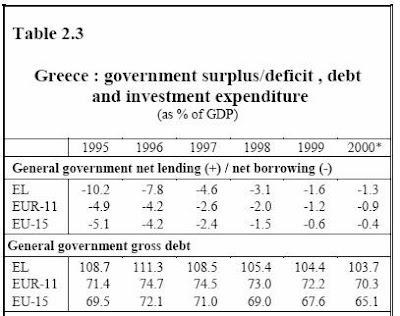
When the statistical cheating was discovered and the deficit data were revised upwards, it was clear that both on the deficit and the debt criterion, Greece would have failed to qualify for EMU membership starting January 2001. The debt ratios remain above 100 percent of annual GDP even today.

Rather than suspending Greece’s membership in the EMU after the discovery of the irregularities in its qualification for admission, and requiring it to qualify again (which would have required at least a two-year transition period) Greece was allowed to continue as a full member without any sanctions. The integrity of the vetting process for the Maastricht criteria was further compromised through this. The message is clear: “do anything necessary to formally meet the criteria at the time”. Cheat if necessary. If you are found out after you are allowed in as a member, nothing will happen to you.”

Recently, the Greek government has discovered that there is a second way of lowering a ratio that is uncomfortably high: if reducing the numerator is not practicable, then increasing the denominator may be an option. Eurostat are currently reviewing the merits of the Greek statistical authorities’ request for a significant increase in measured GDP, reflecting, according to the Greek authorities, the informal sector and other unrecorded economic activity.

4. The problem: the inflation criterion for countries with a fixed exchange rate with the euro

Countries that have a fixed exchange rate with the euro face special problems meeting the inflation criterion for EMU membership. The inflation criterion makes no sense from an economic perspective for countries wishing to join an already existing monetary union when that monetary union has a price stability objective, operationally expressed as a target for inflation in the medium term. The first-best solution would be for all countries wishing to join the EMU and meeting the fiscal, interest rate and exchange rate criteria to be allowed to do so. This is the only solution that makes sense. However, politics and logic are not often encountered in the same space.

Candidate EMU members on a fixed exchange rate with the euro have to deal with the problem that their efficient, optimal rate of equilibrium inflation may well be higher than the existing EMU average. That is because of the Balassa-Samuelson effect. When transition countries with a lower level of productivity and per capita income than the existing EMU average succeed in converging gradually but effectively to the higher levels of productivity and per capita income of the EMU, productivity in the traded goods sectors typically catches up faster than productivity in the non-traded good sectors. The result is that transition countries achieving successful real convergence will experience an appreciation of their real exchange rates. With a fixed nominal exchange rate, real appreciation means higher inflation in the candidate EMU members than in the EMU.

What are the solutions?

One solution would be to abandon the fixed exchange rate regime (the currency board), float the currency and allow it to appreciate in nominal terms for at least a year to get inflation down to the benchmark level. Once that has been achieved, the exchange rate gets locked in irrevocably. I hope that not even the ECB and the Commission recommend such an extraordinary policy sequence. You have the closest thing to a common currency (a currency board); you have to abandon this currency board to float the exchange rate for a year or longer to meet the inflation criterion; if you succeed you get rewarded by going back to where you started from. This would be insane.

Another solution is to create a reduction in the output gap of sufficient depth and duration to bring down the inflation rate to the level of the inflation benchmark. Fiscal policy or credit controls could be used to reduce the domestic output gap and lower inflation. Unless the economy is overheating (that is, unless in addition to the Balassa-Samuelson inflation premium there is also a cyclical inflation premium), contracting demand would mean deliberately creating a recession: a pointless sacrifice of output and employment. It should be rejected.

5. A partial solution: make the euro joint legal tender with the national currency

One way for an EU member wishing to become a full EMU member to give visible expression to its desire for and commitment to eventual full EMU participation, is for it declare the euro to be joint legal tender for all transactions under the country’s jurisdiction, on the same terms as the national currency. This would also allow the country to achieve effectively all of the benefits of full monetary union, with the exception of (1) a share in the ECB’s seigniorage (profits), (2) access to the ECB/ESCB as lender of last resort, and (3) a seat on the ECB Governing Council (further development and discussion of this proposal can be found in Bratkowski and Rostowski (2002), Schoors (2002), Buiter and Grafe (2002), Buiter (2005) and Buiter and Sibert (2006a,b)).

Legal tender, also called forced tender, is payment that, by law, cannot be refused in settlement of a debt denominated in the same currency. Currently, in Estonia, only the Estonian kroon is legal tender. This is clear from the Currency Law of the Republic of Estonia, some key clauses of which are reproduced below in Box 1.[5] An important part of legal tender status is that taxes and fines payable to the state can be paid in legal tender, and that indeed the state can require this.

Box 1

Extracts from the Currency Law of the Republic of Estonia

Clause 3. Legal tender

The sole legal tender in the Republic of Estonia is Estonian kroon. The legal persons and single individuals located in the Republic of Estonia have no right to use any other legal tender except Estonian kroon in the accountancy between them.

Clause 4. Obligation to accept the legal tender of the Republic of Estonia without restrictions

Eesti Pank, as well as all other banks and credit institutions of the Republic of Estonia are obliged to accept the legal tender of the Republic of Estonia without restrictions. Other legal persons are obliged to accept valid coins up to the amount of 20 Estonian kroons at a time, but banknotes without any restrictions.

Clause 5. Exchangeability of Estonian kroon with other currencies

The exchangeability of Estonian kroon with other currencies will be determined by law. The conditions and procedure of exchanging Eesti kroon into foreign currencies will be determined by Eesti Pank.

Clause 71 Refusal to accept legal tender

(1) Refusal to accept legal tender upon sale of or payment for goods or services is punishable by a fine of up to 200 fine units.

(2) The same act, if committed by a legal person, is punishable by a fine of up to 30,000 kroons.

Legally, all that is required to make the Estonian Kroon and the euro joint legal tender in Estonia, is the rewriting the Currency Law of the Republic of Estonia along the lines suggested in Box 2.

Box 2

Proposal for a revised

CURRENCY LAW OF THE REPUBLIC OF ESTONIA

Clause 1. Monetary unit

The monetary units of the Republic of Estonia are the Estonian kroon, which is divided into one hundred cents, and the euro, which is divided into one hundred cents. The cash of the Republic of Estonia is in circulation in the form of banknotes and coins.

Clause 2. Issuing Estonian kroon

The sole right to issue and to remove from circulation the Estonian kroon belongs to Eesti Pank. Eesti Pank determines the denominations of the banknotes and coins as well as their design.

Clause 3. Legal tender

The sole legal tender in the Republic of Estonia are the Estonian kroon and the euro. The legal persons and single individuals located in the Republic of Estonia have no right to use any other legal tender except the Estonian kroon or the euro in the accountancy between them.

Clause 4. Obligation to accept the legal tender of the Republic of Estonia without restrictions

Eesti Pank, as well as all other banks and credit institutions of the Republic of Estonia are obliged to accept the legal tender of the Republic of Estonia without restrictions. Other legal persons are obliged to accept valid coins up to the amount of 20 Estonian kroons at a time or up to the amount of 1.28 euros at a time, but banknotes without any restrictions.

Clause 5. Exchangeability of Estonian kroon with other currencies

The exchangeability of Estonian kroon with other currencies will be determined by law. The conditions and procedure of exchanging Eesti kroon into foreign currencies will be determined by Eesti Pank.

Clause 6. Damaged and spoilt currency

Damaged and spoilt banknotes and coins of the Republic of Estonia will be received and replaced by Eesti Pank and banks authorized by it, in condition that at least half of the banknote is preserved and the serial number is fully legible; on a coin, at least the denomination and time of minting must be legible.

Other legal persons are not obliged to accept damaged and spoilt banknotes and coins.

Clause 7 Refusal to accept legal tender

(1) Refusal to accept legal tender upon sale of or payment for goods or services is punishable by a fine of up to 200 fine units.

(2) The same act, if committed by a legal person, is punishable by a fine of up to 30,000 kroons or 1,917.35 euros.

(3) The provisions of the General Part of the Penal Code (RT I 2001, 61, 364) and of the Code of Misdemeanour Procedure (RT I 2002, 50, 313) apply to the misdemeanours provided for in this section.

(4) Extra-judicial proceedings concerning the misdemeanours provided for in this section shall be conducted by: 1) the Consumer Protection Board; 2) police prefecture.

In principle, a variety of monetary and exchange rate regimes are consistent with having the euro as a parallel currency and joint legal tender. This includes managed and freely floating exchange rate regimes. A fixed exchange rate regime with the euro, and especially a currency board is, however, the natural vehicle for the euro as joint legal tender. It is also a natural waiting room for the eventual full EMU membership.19

Some further refinements

The exchange rate of the Estonian kroon and the euro is 15.64664 Estonian krooni for one euro. That is not a very convenient number. It would make sense to have a currency reform that creates a new Estonian kroon (perhaps called the Estonian eurokroon, or eurokroon for short, whose value is 15.64664 old Estonian krooni. One new Estonian eurokroon would therefore equal one euro - nice and simple.

It would also make sense to make the coins and currency notes of the new Estonian eurokroon sufficiently similar in shape, weight and appearance (without, however, risking accusations of counterfeiting!) that all new vending machines and other electro-mechanical, digital and optical instruments that handle coins and notes can use both euros and eurokrooni interchangeably.

Formally, the exchange rate regime would remain a currency board. In the strict version of a currency board, the entire domestic base money stock (coin and currency and banks’ balances with the central bank) must be backed by international reserves (euros in practice). It would therefore make sense, since there is no opportunity cost involved in replacing domestic coin and currency with euros, to gradually reduce the issuance of krooni coin and currency. Effective complete euroisation of cash could take place without the formal abolition of the domestic currency. The eurokroon would continue to exist, as a numeraire, means of payment/medium of exchange, store of value and legal tender alongside the euro, but you just would not see very many of them.

By encouraging de facto euroisation, that is, the increased use of the euro as the unit of account in contracts (including financial contracts and instruments) and for pricing, as the medium of exchange/means of payment and as store of value, the risk associated with the status of being almost-but-not-quite in the EMU would be much reduced. Exchange rate risk (as regards the exchange rate of the domestic currency vis-à-vis the euro) would cease to be a concern as fewer and fewer contracts and financial instruments are denominated in domestic currency. To avoid giving ammunition to the forces of darkness in Brussels and Frankfurt, however, it is essential that establishing the euro as joint legal tender is not formally and legally the unilateral adoption of the euro as the only legal tender, and the abolition of the domestic currency.

6. The euro as joint legal tender is not unilateral euroisation and is consistent with the provisions and requirements of the Treaty and Protocol for full EMU membership

According to the letter of the Treaty, unilateral euroisation, is not compatible with the Maastricht criteria if it involves the unilateral abolition of the national currency. The argument is that, once the national currency has been abolished, there no longer is any way for the Council of Ministers to determine the irrevocably fixed conversion rate at which the candidate EMU member’s currency eventually joins EMU. The candidate EMU member would have been able to determine its irrevocably fixed euro conversion rate unilaterally. That would be a bridge too far. The ECB and the Commission will have to cross that bridge if and when Montenegro, which has the euro as its sole legal tender today, prior to EU membership, joins the EU and the EMU, but it is too early to speculate about how that conundrum will be resolved.

In addition to Montenegro, the euro plays a key role in the domestic monetary arrangements of a number of small European countries, none of which are formally members of the EU. The euro is legal tender in Monaco, San Marino and Vatican City, which are licensed to issue and use the euro. Like Montenegro, Andorra has the euro as legal tender but is not licensed to issue any euro coins or notes. The same holds for the sub-national entity Kosovo.

There are also some obvious parallels with the pre-Euro Belgium-Luxembourg Economic Union (1922-2002); from 1944, the Belgian franck was joint legal tender in Luxembourg with the Luxembourg franc, and the Luxembourg franc was joint legal tender in Belgium with the Belgian franc (although you would not have thought so, if you tried to pay with Luxembourg francs in Brussels!)

The ECB’s position on the issue is the following “Any unilateral adoption of the single currency by means of “euroisation” outside the Treaty framework would run counter to the economic reasoning underlying Economic and Monetary Union, which foresees the eventual adoption of the euro as the end-point of a structured convergence process within a multilateral framework. Unilateral “euroisation” cannot therefore be a way of circumventing the stages foreseen by the Treaty for the adoption of the euro” (European Central Bank (2003)).

This argument is correct only if unilateral euroisation means the unilateral abolition of the domestic currency and its replacement by the euro. Having the euro as a parallel currency and joint legal tender without abolishing the domestic currency, and leaving the Council of Ministers the opportunity to determined the eventual irrevocably fixed conversion rate between the domestic currency and the euro, is quite consistent with the Treaty and Protocol.[6] There is no circumventing of the stages foreseen by the Treaty for the adoption of the euro. The structured convergence process is not encumbered or undermined in any way.

7. What the euro as joint legal tender does not achieve

Adopting the euro as joint legal tender does not achieve three things:

  1. A seat on the Governing Council of the ECB;
  2. A share of the seigniorage (profits) of the ECB;
  3. Access to ECB/ESCB resources by domestic banks for lender of last resort operations.

These continuing lacunae are, of course, the same ones experienced by the would-be euro area members under their current currency board arrangements. They are ‘deficiencies’ only when compared to a situation of full membership in the EMU. Since there is no reason why adopting the euro as joint legal tender would delay full membership in the EMU, the opportunity cost of doing so is really zero.

8. Safety in numbers

The ECB and the European Commission are unlikely to welcome with open arms the adoption of the euro as joint legal tender. It is my view that there is not much they can do about it. Still, there is safety in numbers. If, say, all four currency board countries in the EU, Estonia, Latvia, Lithuania and Bulgaria, were to take the identical action simultaneously, the odds on even token attempts to interfere with this decision by Brussels or Frankfurt would be negligible.

I also believe that while the official response may be frosty, at best, there is a lot of sympathy for the Baltic countries and a lot of covert support for their ambition to adopt the euro as soon as possible. It is quite likely that the failure of Lithuania and Estonia to become full members in 2007 was just the result of a big error of judgement in Brussels.

I share the view of many observers that those in charge of the EMU convergence assessment in Brussels believed that Lithuania and Estonia would be willing to cheat to achieve membership. The candidate EMU members could have done this by fiddling with VAT or other indirect taxes and by messing with utility tariffs – that’s what Slovenia did, after all, and Slovenia was rewarded for it with EMU membership. They could even have followed the Greek example and simply have doctored the price data. Finally, the great and the good in Brussels and the national capitals probably did not believe it possible that the ECB would produce quite the eruption of self-righteousness and stupidity that it did by denying Lithuania EMU membership when its inflation rate exceeded the benchmark rate by barely one tenth of one percent. There may be a lot of sympathy in Brussels and in many of the EU capitals , and even some surreptitious support for the adoption of the euro as joint legal tender by the currency board countries of Central Europe and the Baltics.

The very creation of EMU was a triumph of political will over technocratic timidity. Distinguished economists (quite a few of them, like Martin Feldstein, from the USA) said it could never happen, and if it happened it would collapse in short order. Perhaps history will repeat itself. Ultimately it is the politicians in the Council of Ministers rather than the technocrats in Frankfurt and Brussels who determine whether a country will be allowed to join the EMU (the ECB and the Commission have only an advisory function). It is therefore possible that a country that starts of by adopting the euro as joint legal tender, may end up with full euroization, not through unilateral euroisation but through consensual euroisation with the blessing of the Council of Ministers. But it is time to press on with joint legal tender regardless.

Conclusion

The frightening financial turmoil of the past few months has provide a stark reminder of the truth that small open economies with unrestricted financial capital mobility have only one sensible monetary option: to join the nearest big currency area/monetary union. This is true not just in Europe. New Zealand is a model of monetary and fiscal rectitude and of deep structural reform. Yet it is a rudderless plaything of the international capital markets. It cannot control its exchange rate. It has to do incredible things to its monetary policy interest rate to keep any kind of control over domestic inflation. It is not surprising that monetary union with Australia is being talked about in responsible policy circles as an option.

For Estonia and the other currency board countries, the earliest possible full membership of EMU is the dominant policy option. To minimize the risk of monetary and financial instability in the period until full membership is achieved, adoption of the euro as joint legal tender is a sensible transitional option. It will not delay the EMU membership process, but it will make the transition less hazardous.

References Bratkowski, A. and Rostowski, J. (2002), ‘Why Unilateral Euroization Makes Sense for (some) Applicant Countries,’ in Beyond Transition eds. M. Dabrowski, J. Neneman and B. Slay, Ashgate

Buiter, Willem H. (2005) "To Purgatory and Beyond; When and how should the accession countries from Central and Eastern Europe become full members of the EMU?". In Fritz Breuss and Eduard Hochreiter (eds.) Challenges for Central Banks in an Enlarged EMU, Springer Wien New York, pp. 145-186.

Buiter, Willem H. and Clemens Grafe (2002), "Anchor, Float or Abandon Ship: Exchange Rate Regimes for the Accession Countries", in Banca Nazionale del Lavoro Quarterly Review, No. 221, June 2002, pp. 1-32.

Buiter, Willem H. and Anne C. Sibert (2006a), "Eurozone Entry of New EU Member States from Central Europe: Should They? Could They?", in Development & Transition, UNDP-LSE Newsletter, 4, June, pp. 16 -19.

Buiter, Willem H. and Anne C. Sibert (2006b), "When Should the New Central European Members Join the Eurozone?", Bankni vestnik - The Journal for Money and Banking of the Bank Association of Slovenia, Special Issue, Small Economies in the euro area: Issues, Challenges and Opportunities, 11/2006, pp. 5-11.

Égert, Balázs, Imed Drine, Kirsten Lommatzsch and Christophe Rault (2003), “The Balassa-

Samuelson Effect in Central and Eastern Europe: Myth or Reality? Journal of Comparative

Economics, vol 31, pp 552–572, in September, 2003.

European Commission (1998), “Convergence Report 1998”,

European Economy, No 65. 1998. Office for Official Publications of the EC. Luxembourg. 411pp. Tabl. Graph. Bibliogr.. CM-AR-98-001-EN-C; ISSN0379-0991.ISSN 0379-0991 http://ec.europa.eu/economy_finance/publications/european_economy

/1998/ee65_98en.pdf

European Commission (2000), “Convergence Report 2000”,

European Economy, No 70. 2000. Office for Official Publications of the EC. Luxembourg. 393pp. Tabl. Graph. Bibliogr.) KC-AR-00-001-EN-C; ISBN 92-828-9708-7; ISSN0379-0991

http://ec.europa.eu/economy_finance/publications/

convergencereports_en.htm

European Commission (2002), 2002 Convergence Report on Sweden, http://ec.europa.eu/economy_finance/publications/

convergence/report2002_en.htm

European Commission (2004), “Convergence Report 2004”, European Economy, Special Report 2/2004. Office for Official Publications of the EC. Luxembourg

http://ec.europa.eu/economy_finance/publications/european_economy

/2004/cr2004_en.pdf

European Commission (2006a), “2006 Convergence Report on Slovenia”, European Economy, Special Report. No. 2. 2006. Office for Official Publications of the EC. Luxembourg. 104pp. Tables, Graphs, Bibliog.) KC-AF-06-002-EN-C; ISBN 92-79-01218-5; ISSN 1684-033X.

http://ec.europa.eu/economy_finance/publications/european_economy

/2006/eesp206en.pdf

European Commission (2006b), “2006 Convergence Report on Lithuania”, European Economy, Special Report. No. 2. 2006. Office for Official Publications of the EC. Luxembourg. 104pp. Tables, Graphs, Bibliog.) KC-AF-06-002-EN-C; ISBN 92-79-01218-5; ISSN 1684-033X.

http://ec.europa.eu/economy_finance/publications/european_economy

/2006/eesp206en.pdf

European Commission (2006c) “2006 Convergence report”. European Economy No. 1. 2006. Office for Official Publications of the EC. Luxembourg. 184pp. Tables, Graphs, Bibliog., KC-AR-06-001-EN-C; ISBN 92-79-01202-9; ISSN 0379-0991., http://ec.europa.eu/economy_finance/publications/european_economy

/2006/ee106en.pdf

European Commission (2007a), “2007 Convergence report on Malta”, European Economy,. No. 6/2007. Office for Official Publications of the EC. Luxembourg.

http://ec.europa.eu/economy_finance/publications/european_economy

/2007/ee0607_en.pdf

European Commission (2007b), “2007 Convergence report on Cyprus”, European Economy. No. 6/2007. Office for Official Publications of the EC. Luxembourg.)

http://ec.europa.eu/economy_finance/publications/european_economy

/2007/ee0607_en.pdf

European Central Bank (2000), Convergence Report 2000, May, Frankfurt am Main, ISBN 92-9181-061-4 http://www.ecb.int/pub/pdf/conrep/cr2000en.pdf

European Central Bank (2002), Convergence Report 2002, May, Frankfurt am Main, ISBN 92-9181-282-X, http://www.ecb.int/pub/pdf/conrep/cr2002en.pdf

European Central Bank (2004), Convergence Report 2004, May, Frankfurt am Main, November, ISSN 1725-9312 (print), ISSN 1725-9525 (online), http://www.ecb.int/pub/pdf/conrep/cr2004en.pdf

European Central Bank (2006a), Convergence Report May 2006, Frankfurt am Main, May, ISSN 1725-9312 (print), ISSN 1725-9525 (online)

http://www.ecb.int/pub/pdf/conrep/cr2006en.pdf

European Central Bank (2006b), Convergence Report December 2006, Frankfurt am Main, December, ISSN 1725-9312 (print); ISSN 1725-9525 (online), http://www.ecb.int/pub/pdf/conrep/cr200612en.pdf

European Central Bank (2007), Convergence Report May 2007, Frankfurt am Main, May, ISSN 1725-9312 (print), ISSN 1725-9525 (online), http://www.ecb.int/pub/pdf/conrep/cr200705en.pdf

European Monetary Institute (1996), Progress towards convergence, November. Frankfurt am Main, ISBN 92-9166-011-6, http://www.ecb.int/pub/pdf/conrep/cr1996en.pdf

European Monetary Institute (1998), Convergence Report; Report required by Article 109 j of the Treaty establishing the European Community, March, Frankfurt am Main, ISBN 92-9166-057-4, http://www.ecb.int/pub/pdf/conrep/cr1998en.pdf

Schoors, Koen (2002), “Should the Central and Eastern European Accession Countries
Adopt the Euro before or after Accession?” Economics of Planning, Springer, vol. 35(1), pages 47-77.

* © Willem H. Buiter 2007

[1] Only Lithuania had its application for membership to start on January 1, 2007 officially rejected. Estonia had decided before the ECB and Commission made a formal, public recommendation, to withdraw its application for membership to start on January 1, 2007.

[4] Italy and Finland joined EMU at its start, on January 1, 1999, even though at the time the decision to admit these two countries was made, they had not yet spent two years in the ERM. This tension is clearly reflected in the language used in the Commission’s Convergence Report. “Although the lira has participated in the ERM only since November 1996, it has not experienced severe tensions during the review period and has thus, in the view of the Commission, displayed sufficient stability in the last two years.” (European Commission (1998, p24). This assessment was made, that is, the examination took place, in March 1998.

As regards Finland, the Commission writes as follows: “Finland has been a member of the ERM since October 1996; in the per iod from March 1996 to October 1996 the Finnish markka (FIM) appreciated vis-à-vis the ERM currencies; since it entered the ERM the FIM has not been subject to severe tensions and Finland has not devalued, on its own initiative, the FIM bilateral central rate against any other Member State’s currency;…” and “as regards the convergence criterion mentioned in the third indent of Article 109j(1), the currency of Finland, although having entered the ERM only in October 1996, has displayed sufficient stability in the last two years.” European Commission (1998, p. 20). In both the Italian and the Finnish case, the statement of the Commission clearly violates the requirement of the Treaty that the candidate country be a member of the ERM for at least two years before the examination.

[6] Note that it might be possible to respect the letter of the Treaty in this regard, while violating its spirit. Consider the case where the euro is made joint legal tender with the national currency, and the candidate EMU member’s own currency is not formally abolished and remains joint legal tender with the euro. The use of the local currency as a means of payment, numéraire and store of value could be discouraged in a variety of ways. In the limit, the last domestic banknote could lead a perfunctory existence, hanging framed on the wall of the office of the Governor of the central bank. The conversion rate ultimately decided by the EU Council of Ministers would be irrelevant if the local currency had de facto if not de jure become defunct.

Murder in the Markets: Whodunnit?

Joint blog by Willem H. Buiter and Anne C. Sibert

An earlier version of this blob appeard in the Financial Adviser, 27 September 2007, under the title: "Walking the line, not chalking it".

A brief history of securitisation and off-balance sheet finance

Once upon a time banks dominated the financial landscape. They raised funds through deposits that could be withdrawn on demand on a first-come-first-served basis. Their assets consisted mainly of loans, both secured and unsecured, to businesses and households. Specialised mortgage lenders (called building societies in the UK) made long-term loans to homeowners secured against property. Northern Rock was one of these. It was a mutual society, not a public limited company. The home loans were non-marketable and therefore illiquid. Its other assets were typically safe and liquid government securities

With liquid liabilities and mostly illiquid assets, banks, including mortgage banks, were vulnerable to ‘runs’. If enough depositors believed their money was safe, they would all keep their money in the bank. If enough depositors believed that enough other depositors wanted to withdraw their money, there would be run and the bank would fail. When there was a run on a solvent, but illiquid, bank, the central bank, acting as lender of last resort (LOLR) stood ready to provide that bank with liquidity by lending to it freely, but at a penalty rate of interest and against collateral that would be good in normal times. The government provided or mandated deposit insurance, at some cost to the banks; government-imposed capital requirements forced banks to hold more capital than they liked. There were restrictions on what banks could do with their assets; serious reporting obligations and thorough independent audits were the rule.

Banks, however, did not like holding illiquid assets. Thus, in the 1970s securitisation was invented and pools of previously illiquid asset were sold to ‘off-balance-sheet’ special purpose vehicles (SPVs) that sliced and diced them, mixed them with other assets, enhanced them in various ways and issued tranched securities backed by the entire asset pool. We got ‘multi-layered securitisation’ as securitised assets themselves became the underlying assets for the next level of securitisation.

There are good aspects to this, pooling assets reduces risk and making non-traded assets tradable enhances opportunities for risk trading. But, securitisation destroys information: the orginator of the loan (often the party that continued to monitor the original mortgage borrower on behalf of the SPV) was now the agent rather than the principal in the investment relationship. Incentives for acquiring information and for monitoring inevitably decline when these activities are delegated. The information that was acquired ended up in the wrong place because it remained with the originators of the loans. By the time a conduit of a German Landesbank bought some tranche of the securitized home loans from a Paris-based hedge fund, neither the buyer nor the seller knew much about the risk associated with the underlying assets.

In came the rating agencies to solve this information problem. How they would acquire the information dispersed among myriad individual originators of the underlying loans was a question no one asked. Moreover, there were conflicts of interest as the rating agencies were paid by the issuers of the products they were rating. They often advised those whose structured investment products they would rate on how to engineer the product to obtain the best rating! The result was a ratings inflation for structured instruments. In the US, triple A silk purses were made out of the pigs ears of subprime-mortgage-backed securities. Regulators could not keep up and central bank warnings about excesses in credit markets were ignored.

Banks also did not like the restrictions, such as capital requirements and reporting obligations, that were the quid pro quo for access to the lender of last resort. Many of them (although not Northern Rock) outsourced their riskier activities to off-balance sheet vehicles and other less regulated or unregulated entities, including conduits or other structured investment vehicles (SIVs), hedge funds and private equity funds. The banks often remained exposed to these entities through credit lines or reputation considerations, but did not pay much attention to this. More information vanished; nobody knew any longer who owned what and who owed what and to whom.

Banks, including Northern Rock, disliked having to raise funds by attracting depositors and found capital markets to be an obvious alternative. Northern Rock de-mutualised and became a regular public limited company. Asset-backed securities (including covered bonds) and unsecured corporate loans permitted a faster expansion of business than the pedestrian process of attracting depositors.

The securitisation and disintermediation boom caused many market players to believe that risk had not only been repackaged, but that it had disappeared. After 2003, credit risk spreads of all kinds shrunk to miniscule proportions, assisted by unduly expansionary monetary policies in the US, Japan and the Eurozone. Low long-term real interest rates further boosted the leverage frenzy in the new financial sector.

Then it happened. In 2006 default rates on US subprime mortgages rose to levels inconsistent with the ratings of the securities they backed. By July 2007, many asset-backed securities markets were becoming illiquid, and de-securitisation was beginning. In August, interbank markets and asset-backed corporate paper markets began to seize up in the US, the Eurozone and the UK. The first victims were hedge funds (in the US and in France) and small banks in Germany that had been directly exposed to the US subprime and other risky mortgage markets. On September 13, Northern Rock had to seek emergency funding from the Bank of England, not because it had any significant exposure to the US subprime sector, but because it was unable to fund itself in the wholesale markets.

Although the bail out of Northern Rock was a joint decision of the UK Treasury, the Financial Services Authority and the Bank of England, these parties’ Memorandum of Understanding (MOU) makes it clear that ultimately the decision belonged to the Treasury: Ultimate responsibility for authorisation of support operations in exceptional circumstances rests with the Chancellor”. This makes sense, because ultimately the tax payer funds the losses when public resources are put at risk. The reputational damage of this debacle, however, affects mainly the Bank: it had to provide the line of credit within days of taking a strong public line against bail outs.

Northern Rock engaged in reckless borrowing. It could not survive without external assistance not because its assets were bad (its exposure to the US subprime market is tiny) but because it used a high-risk funding policy to finance its breakneck expansion, with three quarters of its funds coming from the wholesale markets rather than from depositors. It gambled and lost and it urgently needs a buyer with deeper pockets and a more sensible funding strategy.

Northern Rock’s bail-out cannot be justified on systemic financial stability grounds: as the UK’s fifth largest mortgage lender it is just too small to be a threat to financial and economic stability. A bail out should only be undertaken if there is, in the words of the MOU, “… a genuine threat to the stability of the financial system to avoid a serious disturbance in the UK economy.”

Ironically, the Liquidity Support Facility failed to restore confidence and a run on the deposits of Northern Rock developed. Calm was restored only when the Chancellor guaranteed in full all deposits of Northern Rock and of any other bank that might be granted recourse to a Liquidity Support Facility in the future. Instead of this socialisation of UK-wide depositor risk, it would have been preferable to take Northern Rock into public ownership. It could have resumed operations immediately in support of its existing commitments and could have been re-privatized at some later date.

Getting the monetary authority out of the Lender of Last Resort business and into the Market Maker of Last Resort business

We believe that the Bank’s understanding of the distinction between its Lender of Last Resort (LOLR) role for individual banks and its responsibility for providing broad liquidity support for financial markets, and specifically for the longer-term money markets (see e.g. the Governor’s Paper submitted to the Treasury Committee on12 September 2007), is flawed. The Bank should support key financial markets and other institutions such as the payments system and the clearing and settlement systems. The Bank should leave bailing out individual banks to the FSA, which has the institution-specific knowledge, and the Treasury, which can call on tax payers for funding. Ending the active role of the monetary authority as LOLR would require the FSA to have a credit line or overdraft facility with the Bank, guaranteed by the Treasury and would require a change in the MOU. The Bank would take no part in the decision as to whether some bank should be bailed out, and the Bank’s role in funding any bail-out decided by the Treasury and the FSA would be entirely passive.

Bank intervention in longer-term money markets

The Bank has made a mistake in its unwillingness to intervene at longer maturities than the overnight market. The Bank’s own primary money market objective is for “Overnight market interest rates to be in line with the official Bank Rate, so that there is a flat money market yield curve, consistent with the official Bank Rate, out to the next MPC decision date ….”. This means that, following the last MPC meeting on 6th September 2007, when there was a month to go till the next scheduled MPC meeting, the one-month interbank rate on unsecured lending (LIBOR) should have been close to the Bank’s policy rate of 5.75%. In fact it was only just below the three-month LIBOR rate of 6.68% (see Chart 1).

There are four explanations for the sizable spread of three-month LIBOR over the Bank Rate. The first is an expectation that the Bank Rate will rise over the next three months, but this highly unlikely. Second, there could be a pure term premium, but this must be tiny over such a short horizon. Third, there is a risk that borrowers will default. This is clearly not zero, but it is difficult to believe that there is a one percent probability that a typical UK money centre bank will default with a zero recovery rate during the next three months. Finally, there is a liquidity risk and we attribute the lion’s share of the recent spread of three-month LIBOR over Bank Rate to liquidity factors.

Currently liquid banks may be reluctant to make three month loans, not because they are afraid that their borrowers will be insolvent in three months, but because they are afraid that both they and their borrowers will be illiquid in three months. If enough banks have these fears, an interbank ‘lending strike’ results.

Banks everywhere are gearing up to take on their balance sheets the illiquid assets of conduits, other SIVs and other off-balance sheet SPVs that they are exposed to through credit lines or reputational considerations. Fear of future illiquidity is widespread and banks are hoarding excess liquidity rather than lending it out in the interbank market, even at nearly seven percent. The Bank could address this unfortunate situation by injecting liquidity, through repos with, say, a three-month maturity to eliminate the liquidity premium. Such repos are likely to be more effective if they are against a wider range of eligible collateral that what the Bank currently accepts, including illiquid assets.

It is true that the ECB’s massive injections of three-month have not prevented significant spreads (albeit lower than in the UK) of Euribor over the policy rate in the Eurozone (see Chart 2). But, in the United States, the spread on three-month LIBOR has fallen to less than 50 basis points since the Fed lowered its discount rate by 50 basis points on 17 Aug 2007, in addition to more modest open market and discount window operations (see Chart 3). However, what is most important is not the spread, but the amount of lending taking place. In the UK 3-month LIBOR has become the rate at which banks will not lend to each other.

The Bank as Market Maker of Last Resort

We have proposed (Willem H. Buiter and Anne C. Sibert “Three Steps to Calm the Storm”, Financial Times Comment, 5 Sept 2007) that the Bank should accept a wider range of collateral, including lower-rated illiquid private assets, as long as it is punitively priced, and subject to a suitable ‘haircut’ (discount) as well. The Bank should ‘make market’ for such illiquid securities, by holding auctions in which it purchases these securities; it should then hold them on its books, taking the credit risk, until they can be sold off again under more orderly market conditions, preferably at a profit for the tax payer. To encourage participation by investors who do not want to mark-to-market their securities, the Bank and FSA could require that all similar securities not priced at the auction be marked-to-market at the price established in the auction.

There would probably have been no need for a bail-out of Northern Rock if the Bank of England had had a sensible collateral policy for its regular open market operations. Unlike the ECB and the Fed, the Bank only accepts European Economic Area sovereign debt instruments, high quality debt issued by a few international organisations and, exceptionally, US Treasury debt. More sensibly, the ECB also accepts private securities rated at least A-, including asset-backed securities. If Northern Rock had a Eurozone subsidiary, it could have funded itself through the eurozone three-month repos conducted by the ECB last week, using its high-grade mortgages (or securities backed by them) as collateral. The Fed can, in an emergency, accept anything it deems appropriate as collateral at its discount window, not only from banks, but from individuals, corporations and non-bank financial institutions as well.

On September 19, the Bank suddenly had a double change of heart: it announced it would initiate repurchase operations at 3-month maturity and would accept as collateral private assets, including mortgages.

Secrecy

We know that the Chancellor authorised the Bank to “provide a liquidity support facility to Northern Rock against appropriate collateral and at an interest rate premium.” But, this is not sufficient information. Is the support uncapped and open-ended, as Northern Rock informs us? What is the premium charged for the use of the facility? What is the arrangement fee for the facility? Exactly what collateral will be offered, how will it be valued and what ‘haircut’ will it be subject to? The public are funding this risky venture and they are entitled to know. There is no commercial confidentiality argument for keeping any of this information secret. The accountability of the Bank and the Treasury are at stake. The Chancellor should provide this information forthwith, and if he does not, Parliament should insist.

Credibility

The Chancellor, and possibly also the FSA and the Bank, do not want even a systemically insignificant mortgage lender to fail on their watch, regardless of the moral hazard created by the bail-out. The Chancellor is willing to risk tax payer money to prevent it. The Bank, however, should not be directly involved in the decision making; nor should it play an active role in the funding of the liquidity support facility. Depositor protection is the job of the FSA and the Financial Services Compensation Scheme. Redistribution of income belongs to the Treasury. If the Bank remains an active participant in an inherently political bailout process for individual banks, the Bank’s independence in the realm of monetary policy could be compromised.

Charts Source: Bank of England

Source: European Central Bank

Source: Federal Reserve Board

Saturday, September 29, 2007

Redesigning the UK Financial Stability System

A pdf file of a Powerpoint presentation titled "What should the authorities have done?", prepared for The London Financial Regulation Seminar, 'The Financial Crisis Conference' on October 1, 2007 at the London School of Economics, can be found here.

The mess surrounding the rescue operation for Northern Rock demonstrated that the UK’s Tripartite arrangement for handling financial crises is not working properly.

There are three distinct sets of problems. First, the UK deposit insurance scheme is both limited in the degree to which it guarantees retail deposits and too slow in paying out on any claims submitted under the scheme. Second, the division of labour among the Treasury, the Bank of England and the Financial Services Authority, as expressed in the Memorandum of Understanding, was disfunctional, mainly because it separated the agency in possession of the relevant information from the financial resources to act effectively upon that information. Third, the Bank of England’s liquidity-oriented open market operations through repos, and its discount window are flawed in three ways: first, the eligible collateral is too restricted; second, the maturity of the operations (loans) is too short; and, third, the list of eligible counterparties is too restricted.

Specifically, five issues can be raised about the current set of arrangements:

(1) The UK deposit insurance arrangements did not work properly.

(2) The lender of last resort (LOLR) mechanism for dealing with individual financial institutions in distress did not work properly.

(3) The Bank of England’s Standing Lending Facility (its discount window) did not work properly.

(4) The Bank of England’s liquidity-enhancing open market operations did not work properly.

(5) The financial stability mess, and the Bank’s about face as regards the collateral requirements and the maturity of its liquidity-enhancing open market operations have created confusion about exactly what it is the Monetary Policy Committee decides on when it sets the official policy rate, or Bank Rate.

All these points will be considered in what follows.

Deposit insurance This needs to be overhauled to provide guaranteed 100 percent cover up to, say, £50,000.00 per person per institution. This would correspond to the level of coverage currently in effect in the USA ($100,000). The £100,000.00 figure that has been bandied about seems excessive. The same person could have accounts in different institutions. Provided these institutions are indeed separate legal entities, the same person could have £50,000.00 insurance cover in each one of number of separate banks.

The insurance should be for retail accounts only. Wholesale deposits would not be covered. A simple rule could be that only deposits owned by natural persons would be covered. Deposits of entities with legal but not natural personality (partnerships, charities, companies etc.) would not be covered.

Apparently, the Chancellor’s deposit guarantee for Northern Rock covers not only all deposits (retail and wholesale), but most other unsecured creditors of Northern Rock as well. Only holders of subordinated debt appear not to be covered. This degree of coverage is ludicrously excessive. Such ex-post insurance and socialisation of investment risk by municipalities, charities and other institutions who were chasing the above-market rates offered by Northern Rock is without justification on equity, efficiency or systemic stability grounds. For these non-widows and non-orphans, the lesson that above-market returns often represent risk premia, and that risk has the unpleasant habit of materialising from time to time, would have been a highly salutary one.

The deposit guarantee scheme should be able to pay out on claims effectively instantaneously, and certainly no longer than 2 working days after a claim has been submitted. The current situation where a bank that goes into administration has its deposits frozen, clearly has to be addressed with legislation.

Deposit insurance, or any form of consumer protection, should not be the responsibility of the monetary authority. The FSA would be a natural body for administering it. The scheme should be self-financing, through levies on the deposit-taking industry. Should there be widespread insolvency in the banking sector, the financial resources to meet the deposit insurance guarantee might exceed the combined resources of the deposit-taking institutions. For such system-wide calamities, a fiscal back-stop would be required. One easy way to do this is to give the deposit insurance agency an overdraft facility with the central bank (the Bank of England), guaranteed by the Treasury.

Liquidity provision

The UK’s arrangements for dealing with illiquid institutions and illiquid markets are a shambles.

Open market operations The Bank has to extend its recently announced policy of providing liquidity to the markets at maturities longer than overnight and against a wider range of collateral. It should effectively adopt the policies of the ECB and the Eurosystem, which accepts as collateral in repos (overnight and at longer maturities), private instruments, including illiquid and non-marketable instruments, as long as they are rated at least in the A category. Clearly, intervening in the markets at the same time in different maturities makes no sense when markets are orderly; when markets are disorderly, however, there may be extraordinary liquidity premia at different maturities (on top of the regular term premia, conventional market risk or default risk premia and expectations of future changes in the policy rate) that can be influenced both by repos at varying maturities and by outright purchases of securities with differing remaining maturities. Such open market purchases or outright purchases should not be at penalty rates. This would blur the distinction between open market operations and discount window operations. The Bank of England’s 3 month repos against illiquid collateral (mortgages and mortgage-backed securities) (the first of which did not attract any takers) was therefore in my view a mistake.

The discount window

For illiquid but solvent institutions, the discount window at the Bank of England (its Standing Lending Facility) has to be the port of call. As currently constituted, the Bank’s Standing Lending Facility is useless: its list of eligible collateral is too restrictive - all it does is trade longer-maturity liquid assets for instantaneous liquidity; it only lends overnight; and it only lends to banks. This discount window should be modified in three ways.

(1) The Bank should create a wider range of eligible collateral. The Bank of England should accept as collateral at its discount window (Standing Lending Facility) private securities, including illiquid and non-marketable private securities. Their market price or fair value would be subject to a ‘haircut’ that would be larger to the more illiquid the collateral that is offered. Where no market price is available, the Bank should ‘make market’ for the illiquid securities, by holding auctions in which it purchases these securities; it should then hold them on its books, taking the credit risk, until they can be sold off again under more orderly market conditions, preferably at a profit for the tax payer. To encourage participation by investors who do not want to mark-to-market their securities, the Bank and FSA could require that all similar securities not priced at the auction be marked-to-market at the price established in the auction.

(2) The Standing lending Facility should offer longer maturity loans than overnight. The Fed already offers up to 1 month maturity loans. I see no reason why both 1 month and 3 month collateralised loans could not be offered at the discount window. The penalty rate (current 100 basis points for overnight loans) could be made to increase with the maturity of the loan, say 150 basis points for 1 month maturity and 200 basis points for 3 month maturity. The Fed’s decision to cut the penalty premium of the discount rate over the policy rate from 100 basis points to 50 basis points was a big mistake – pandering to the profits of those banks willing and able to borrow at the discount window.

(3) There should be a wider range of eligible counterparties. In the UK the Standing Lending Facility of open only to a limited number of banks and other deposit-taking institutions. I would favour widening this to all financial institutions that are subject to and meet the demands of, a regulatory and supervisory regime approved by the Bank. This could include investment banks, hedge funds and private equity funds. The Fed can do much more than that, and can, in principle, open its discount window to individuals, partnerships and corporations (financial and non-financial).

With (1), (2) and (3) in place, it is clear that the Standing Lending Facility, which is open to all eligible institutions on demand, and for any amount of funding for which they can provide eligible collateral, is not so much part of the traditional lender of last resort arsenal, which is targeted at specific institutions that are in trouble, but instead is a form of market support, specifically support for markets trading normally liquid securities that have become illiquid.

The Lender of Last Resort

Institutions that are insolvent as well as illiquid should not be bailed out unless they are deemed to be systemically important. It is hard to think of any bank in the UK that would be systemically signficant, once adequate deposit insurance removes the risk of bank runs. Bail-outs should therefore be for two kinds of institutions: those that are illiquid and about whose solvency there is some uncertainty and those that are insolvent and systemically important.

The decision on whether to bail out the institution should be made by the regulator (the FSA), which has the institution-specific knowledge and information, and the Treasury, which has the resources. The Bank of England’s input will not doubt be required, as it is the systemic significance of an individual institution or set of institutions that is at stake, and the primary responsibility for and understanding of systemic risk is presumably found in the Bank.

Should the Standing Committee on Financial Stability (chaired by the Treasury, with representatives of the Treasury, the Bank and the FSA) decide that a specific institution needs to be bailed out, there are a number of options.

For a bank that is illiquid and perhaps insolvent, the kind of dedicated lending facility created for Northern Rock would be appropriate. It wouldn’t be named a “liquidity support facility”, since more than an injection of liquidity may be required. It is clear that such a LORL facility targeted at an individual institution should not be initiated or managed by the Bank. The Bank does not have the information about individual institutions. It should not be asked to take decisions about individual institutions. Nor should it be required to put its resources at risk.

The institution that should decide who gets a LOLR facility has to be the regulator and supervisor, that is, the FSA, because only the FSA has the necessary information. It does not, however, at the moment have the financial resources to act as LOLR. It should therefore be given the resources to fulfil the LOLR function. These resources can only come from the Treasury. Operationally, this could be done conveniently through a credit line or overdraft facility of the FSA with the Bank (uncapped and open-ended), guaranteed by the Treasury. The Bank’s role in the LOLR function vis-à-vis individual banks is therefore entirely passive. The decision is made by the FSA and the Treasury and the funds are provided through the FSA by the Treasury. There would be a presumption that the existing management of a bank in need of an LOLR facility would be fired, sans golden parachute.

Insolvency and public ownership

The facility would be operated until it is clear to the FSA whether the troubled bank is insolvent or not. If it is solvent, it is weaned off the facility. If it is deemed to be insolvent and systemically insignificant, it goes into the normal (hopefully revised) insolvency procedures for banks. If it is insolvent and deemed to be systemically important, it is taken into public ownership, rather like Railtrack was. Once in public ownership, the bank could continue to operate and meet its existing commitments.

The nationalisation would be temporary. Once orderly conditions have been restored and the value of the bank’s assets and liabilities has been established, the bank can be privatised again as a going concern, sold off in toto to its competitors or liquidated, broken up and sold in parts. The incumbent management would presumably lose their jobs as soon as the bank was taken into public ownership, if they had not already lost it while the bank was using the LOLR facility (if it went through the LOLR process earlier on, because its insolvency was then not yet obvious). After compensating itself for the cost of the LOLR facility, the FSA would pay the creditors of the bank, including those depositors who were not covered by the deposit insurance scheme. The original shareholders of the bank would be last in line and would, if the bank was indeed insolvent, receive nothing.

The schematic below shows how illiquid institutions would be dealt with in a new, improved Tripartite Arrangement. OMOs + and Discount Window + stand for the augmented open market operations and discount window operations I advocated earlier (wider set of eligible collateral, longer maturities, wider set of eligible counterparties at the discount window and in OMOs.)

The overdraft facility or credit line with the Bank of England, guaranteed by the Treasury, which the FSA would have, could serve both to finance its LOLR activities and its deposit insurance activities, were these to exceed the financing capacity of the banking system.

What does the MPC set when it sets Bank Rate?

The monetary policy committee of the Bank of England sets Bank Rate. What is Bank Rate? Under the current set of arrangements for implementing monetary policy, the Official Policy Rate, or Bank Rate, is the target rate for the overnight sterling interbank rate (also called the sterling money market rate). This target is pursued through the sale and purchase of ‘repurchase agreements’ (repos and reverse repos). To the layman these are collateralised loans.

You will be forgiven for wondering why, if the MPC sets the target rate for the overnight rate, the actual overnight rate in the interbank market can ever differ from that rate. Basically, there are two reasons for any discrepancy between Bank Rate and the overnight interbank rate. The first is that the Bank does not rigorously fix the repo rate every minute of very day. They could do this. They could simply stand ready to repo or reverse repo at any time any amount the private sector wants to throw at them. They don’t do that. Instead they inject a certain amount of repos or reverse repos into the market – and amount they expect will meet the normal market demand, and wait to see what happens. Why they do this, I do not know. I think it would be helpful if they simply pegged the repo rate by standing ready to buy or sell in any amount at that rate.

The second reason why the actual overnight interbank rate can differ from Bank rate, is that the overnight repo rate can differ from the overnight interbank rate. This is simply because the overnight interbank rate is a rate on unsecured lending, why the repo rate is a rate on a collateralised, secured loan. When the Bank of England expands liquidity through a repo, the loan to the private sector is almost free of default risk. Both the borrowing bank and the issuer of the collateral would have to default for the Bank to be exposed to counterparty risk through the repo. When a bank lends to another bank overnight in the interbank market, there always is a small probability that the borrowing bank will fail overnight.

Once there is counterparty risk, illiquidity risk becomes a possibility. So there can be a gap between the overnight repo rate and the overnight interbank rate because of market perceptions of default risk and illiquidity risk.

It would clarify the division of labour between the Bank of England’s Monetary Policy Committee and those in the Bank of England responsible for market operations and financial stability, if the Bank were to give the highest priority to its task as agent for the MPC, by keeping the overnight interbank rate as close as possible to Bank Rate. I would start by pegging the overnight repo rate, undertaking repos or reverse repos in any amount required to keep the market repo rate equal to Bank Rate throughout the maintenance period. Market perceptions of overnight default risk is, of course, not something the Bank of England should try to do anything about. Overnight illiquidity can, however, be addressed, by injecting additional liquidity into the repo market, over and above what is required to keep the overnight repo rate at the level of Bank Rate, up to the point that the overnight interbank rate, minus the market’s counterparty risk premium, is at the level of Bank Rate. It is possible that this requires the overnight repo rate to be below Bank Rate. So be it.

The Bank’s operations in the money markets at maturities longer than overnight, and the Bank’s Standing Lending Facility operations are not part of the remit of the MPC.

The company we keep

The merits of an argument or the truth of a proposition are independent of the motives and the moral character of the person making the argument or advancing the proposition. Still there are times when I go back to the intellectual drawing board for further scrutiny of fact and logic simply because of the source of the support or opposition that I encounter when I advance a particular argument. The most telling example was a comment on a blog on racism and freedom of speech I received from a KKK member in the US, who wrote he quite agreed with me on freedom of speech, but took a line different from me on racism. Another example was the letter I received in response to a blog by Anne Sibert and myself on the National Health Service , first published in the Daily Telegraph - arguing for its abolition and replacement by a continental European-style comprehensive and mandatory insurance mechanism. The author informed me that we made "...no mention that the NHS has been weakened and weighed down by the enormous number of immigrants entering this country since its formation,...". Perhaps I should have sent him the following answer: I know exactly what you are talking about. Immigrants - they're everywhere. I even got four of them living in my own home: my son (from Peru), my daughter (from Bolivia), my wife (from the USA) and myself (from the Netherlands). Sometimes being judged by the uninvited company you keep can be rather embarrassing. Still, just because Hitler, Stalin, Mao and Pol Pot probably would have agreed with me, most of the time, that two plus two equal four, is no reason for abandoning that bit of arithmetic. So we hold our noses and proceed.

Wednesday, September 26, 2007

Support markets, not banks

An earlier version of this blog appeared as a comment on Larry Summers' contribution to Martin Wolf's Economists’ Forum, "Beware the moral hazard fundamentalists",

Larry Summers' contribution contains a nugget of sense about liquidity, but this is buried deep under several layers of dross about moral hazard – a term I consider unhelpful. Its use encourages getting sidetracked into a didactic, essentialist argument about whether the bail-outs and other official financial support operations under discussion are indeed creating moral hazard in the strict insurance-technical sense of the word. What we should be talking about is bad incentives producing bad - inefficient and inequitable - outcomes.

Providing liquidity to support markets

Liquidity is a key property of assets. It refers to the ability to sell the asset at short notice and at low transaction cost at a price close to its fundamental or fair value (fundamental or fair value is what you would pay for the asset if it could be bought and sold instantaneously and at zero transaction cost, that is, if ownership could be transferred costlessly and instantaneously). Liquidity is distinct from maturity or duration. Securities can have long remaining maturities or duration, yet be highly liquid because of the existence of deep, well-functioning secondary markets. Market liquidity is about trust and confidence. When normally liquid markets dry up, only the central bank can provide the public good of trust that restores liquidity swiftly and at little or no private or social cost. So it should be done.

More formally, correcting or mitigating market failure need not distort private incentives; injecting liquidity into a market that has become illiquid need not create moral hazard by distort private incentives for appropriate risk management in the future. Markets, that is, mechanisms for matching willing buyers and sellers at a price acceptable to both, are, in the case of assets like securities (or any store of value that can be resold in the future), subject to an inherent network externality: the likelihood of my being willing to buy a security at a price close to its fundamental or fair value is a an increasing function of the likelihood I attach to my being able to find a willing buyer for that security in the future at a price close to its future fundamental or fair value. When I believe that (1) I may have to sell the security in the future (possibly unexpectedly) and that (2) the future probability of finding a buyer is high, I am likely to buy now. If there are a lot of market participants with similar beliefs, the market today will be liquid. If there are a lot of market participants today with pessimistic beliefs about finding a future buyer at a price close to future fair value, the market today will be illiquid. Such a market will have at least two kinds of equilibria. One has self-fulfilling optimistic beliefs about future liquidity. Such a market will be liquid today. The other has self-fulfilling pessimistic ideas about future liquidity. Such a market will be illiquid today.

When the bad (illiquid) equilibrium prevails, one way to move to the good (liquid) equilibrium is for an agency whose liabilities have unquestioned perfect liquidity to inject liquidity into that market. In doing so it supports the market for the illiquid security. It does not bail out individual private businesses, that is, it does not act as a Lender of Last Resort (LOLR). The action will help the private businesses that hold the illiquid securities, but this assistance efficient: it corrects a distortion. The intervention renders liquid those securities that, because of fundamentally arbitrary albeit self-fulfilling beliefs, have become illiquid. The agency acts as a Market Maker of Last Resort (MMLR). The central bank is the natural agency to ‘liquidify’ (or should that be ‘liquefy’?) normally liquid markets that have become illiquid. That is because it is the source of ultimate, unquestioned, costless and instantaneous liquidity – the monetary liabilities of the central bank: commercial bank reserves with the central bank and currency.

Unlike the Fed and the ECB, the Bank of England does not appear to understand the nature of market liquidity and what could cause it to disappear and reappear. Instead of thinking of liquidity as a public good, it thinks of it as a private good that should be managed by individual financial institutions the same way they manage default risk or price risk.

Indeed, liquidity can be managed privately. Commercial banks could hold as assets only things that are highly liquid, like reserves with the central bank and government securities for which the secondary markets are normally deep and orderly (Treasury bills, gilts etc.). This would eliminate liquidity risk. However, such highly liquid asset portfolios would be socially inefficient (as well as unprofitable). We want our intermediaries to intermediate in support of long-term commitments by households and non-financial corporations. Some of the most productive assets are inherently illiquid. Someone has to hold them. If it can only be the originator of the illiquid asset (say a private entrepreneur investing in plant and equipment) the productive efficiency of the economy would be gravely impaired. Confidence that when some key financial market becomes illiquid, the central bank will support that market, by acting as MMLR (or buyer of last resort), is essential if our economy is to optimise its ability to generate productive but illiquid assets.

The Bank of England, until it changed its mind last week and decided to intervene in the 3-month repo market against illiquid collateral (mortgages), appeared to believe that any market operations by the Bank at longer than zero maturity (overnight), represented a bail-out of all potential or would-be sellers of the illiquid collateral. That is a nonsense. It may be that some banks and other financial institutions indeed had too few liquid assets on their books, even for orderly market conditions. In that case, charging a premium over the Bank’s marginal cost of funds (Bank Rate) on the Bank’s lending in the 3-month repo market makes sense. The Bank has decided to do so, setting the rate it charges for access to the Standing Lending Facility (the Bank’s discount window, 100 basis points above Bank Rate) as the floor for the rate it will charge on its 3-month repos. It should also value the illiquid collateral according to its fair value rather than its face value, and impose other constraints to safeguard the interests of the tax payer. Finally, it should impose an appropriate haircut (discount) on the (conservatively estimated) fair value of the collateral. If all that is done, market liquidity support (overnight or at a 1, 3, 6, 12 or 24 month horizon) is not a reward for past reckless lending or borrowing. It is correcting a distortion - mitigating market failure.

Bailing out undeserving private financial businesses

Larry’s rather blanket support for bailing out distressed financial businesses (as distinct from supporting markets) is quite unconvincing. Arguments by analogy are cute but prove nothing. No, smoking in bed is not an argument against have a fire department. It is, however, an argument for having a clause in the homeowners’ insurance contract stating that no valid claim exists if the house burns down because one of the occupants was smoking in bed.

Contagion (in the sense of irrational herd behaviour) is as frequently mentioned (and modelled in neat academic papers) as it is uncommon in practice. When many private institutions or many countries are being dragged down by a common tidal wave, it tends to be because they have the same flawed fundamentals, not because of contagion. Contagion is an argument for deposit insurance, if the contagion takes the form of panicky depositors. It takes the form of market support (MMLR) action rather than support for individual financial businesses (LOLR) action if the contagion affects the liquidity of the markets for other financial instruments. State entities, including the central bank, the deposit insurance agency and the Treasury should support markets and other social mechanisms with clear public good properties, like the payment, settlement and clearing systems. Individual private businesses should be directly supported only if this is necessary for the safeguarding of some socially valuable ‘institution’ (in the proper sense of the word institution, as opposed to its use in financial ‘institution’, where it simply means ‘business’).

I cannot think of a single financial institution that is too big to fail, in the sense that it would damage some systemically important social institution. If deposit insurance is deemed important, whether because deposits are deemed an important part of the payment mechanism or because of distributional, social or political concerns, let’s guarantee deposits, but allow the institutions issuing them to fail. In the UK, Northern Rock was both granted an uncapped and open-ended Liquidity Support Facility (credit line) with the Bank of England and an unlimited guarantee for its existing depositors (and most other unsecured creditors, except for the holders of subordinated debt!). You might be able to make a case for either one of these support interventions, but not for both.

To hold out the disgraceful bail-out of LTCM as an example of how to act in a crisis is extraordinary. Indeed no public money was involved. But the Fed (through the Federal Reserve of New York) put is reputation at risk, and in my view damaged it severely, by enabling and facilitating this shoddy arrangement - offering its ‘good offices’.

As a result of the bail-out of LTCM, there was never any serious effort to address the potential conflicts of interest arising from simultaneously financing hedge funds, investing in them, and making money executing trades for them, as many investment banks did with Long-Term Capital. The results are there today for all to see. Things were even worse because apart from the inherent potential conflict of interest that is present whenever a party is both a shareholder in and a creditor to a business, the bail-out created a serious corporate governance problem because executives of one of the financial institutions that funded the bail out had themselves invested $22 mln in LTCM on their personal accounts. Using shareholder resources for a bail-out of a company to which you have personal exposure is unethical, even where it is legal.

To crown it all, the founders of LTCM were allowed to retain some equity in the firm, supposedly because only they could comprehend, work out and unwind the immensely complex structures on its balance sheet. These were the same people whose ignorance and hubris got LTCM into trouble in the first place. Any handful of ABD graduate students from a top business school or financial economics programme could have unravelled the mysteries of the LTCM balance sheet in a couple of afternoons. This was the market establishment looking after its own. The bail-out of LTCM smacks of crony capitalism of the worst kind. The involvement of the Fed smacks of regulatory capture.

It is clear from Larry’s record at the World Bank (1991-1993) and at the US Treasury (from 1993 till 1995 as Under Secretary of the Treasury for International Affairs, from 1995 till 1999 as Deputy Secretary of the Treasury and from 1999 till 2001 as Secretary of the Treasury), that he has never seen a potential bail out he did not like: the United States support program for Mexico in the wake of its 1994-1995 financial crisis, the international response to the Asian financial crisis of 1997 and the 1998 Russian crisis and the Fed’s response to the 1998 LTCM crisis. I recognise the upside of bail-outs for those who arrange them: they look like movers and shakers, making and shaping events. It’s heroic, in an industry where heroism can be rarely displayed. But in all of the examples mentioned above, the bail-out did more harm than good.

Finally, Larry needs to add at least two other questions to his list of three ((1) Are there substantial contagion effects?; (2) is there a liquidity or a solvency problem?; (3) will there be costs to the tax payer?) central banks ought to ask themselves during financial crises. These are:

(4) Will this action (Lender of Last Resort bail-out of individual private financial businesses, Market Maker of Last Resort liquidity injections into the markets) have a material impact on the likelihood and severity of future financial crises?”

(5) Will this action produce any net social benefit?